

Impact Training

How To Organise A Speech | # 1 Guide For Definite Success

.”Miss Barrow…” my client began in her familiar Bajan drawl. “You don’t have anything on how to organise a speech on your website…”

“Really…” I said evasively. But I knew she was right, even as I asked myself: how did I make such an omission?

You see, before you begin writing your speech, you have to think of a clear, specific, easy-to-understand structure for that speech and organise your material in a way, following that format.

Why? Because if a speech is to achieve its purpose, your audience must be able to follow it and be able to accept your ideas, remember what you said and take the action you want them to.

And your standard or guide cannot be all those speeches that you did not understand, but believed they must have been well done because everyone applauded.

So I’m correcting the gap my client pointed out, while at the same time, giving you this comprehensive guide on how to organise a speech.

But first, your key takeaways:

Image showing an off-camera adult using the steps to organise a speech

Key Takeaways:

Following this guide, when you next organise a speech, you will know how to:

  1. Narrow down your topic
  2. Locate your ideas and information
  3. Structure your speech
  4. Apply the “All-Purpose -All-Speech” structure 
  5. Prepare the body of your speech
  6. Design an appropriate introduction
  7. Plan a meaningful ending 

Step #1: Narrow down your topic

Yeah…you have to narrow down your topic as the first step in organising a speech. Don’t believe me?

Check out this scenario.

You are minding your business – relaxing by the beach – and your phone rings.

It is the President of your son’s PTA and she wants you to be the guest speaker at the upcoming Annual Installation of Officers Ceremony – if you will be available.

No problem. What does she want you to speak about?

“Oh! anything to do with “deviant youth” she replied glibly.

Really? Even with your job as Probation Officer in the Ministry of Youth, that topic is dangerously broad.

So you now have to use the President to tell you something about the audience to help you create an appropriate topic for that audience. 

Until you narrow down your topic, to something like “What Parents Can Do to Reduce Youth Deviance” you can’t easily proceed to the next step…

Step #2: Locate your ideas and information

 Where do you begin to do this?

The popular place for information and ideas these days is the internet and or AI.

But before you go to these sources, check inside your head. It’s not as empty as it feels since you were invited to deliver the speech.

Write down any ideas and information which you already have on the topic you want to speak about. Those ideas and information are yours and can keep your speech original and fresh.

Next, ask yourself what other information you need to support what you plan to say and where can you find it. In other words, what and where and the specifics.

The specifics are the details, data, information, etc which support the point you want to make. Specifics come in many forms: Examples – Quotation – Statistics – Stories – Definitions, etc.

Specifics have four (4) main purposes:

  1. to prove a point
  2. to clarify a point
  3. to make a point memorable
  4. to add interest to your speech

There will be many sources for your specifics but try to keep you research focused on your speech otherwise you might find yourself a victim of information overload.

Step #3: Determine a structure for your speech

An important part of organising a speech is to have a clear, specific, easy-to-understand structure and organise your material in such a way that follows this format.

This not only helps you to write a great speech but it also builds your confidence before your speak.

In this regard, I’ve done the heavy lifting for you.

Below is an “all-purpose – all speech – structure”, a simple way to organize almost any speech.

This structure can be used if you’re having a casual talk to your hiking pals or addressing an Awards Ceremony. 
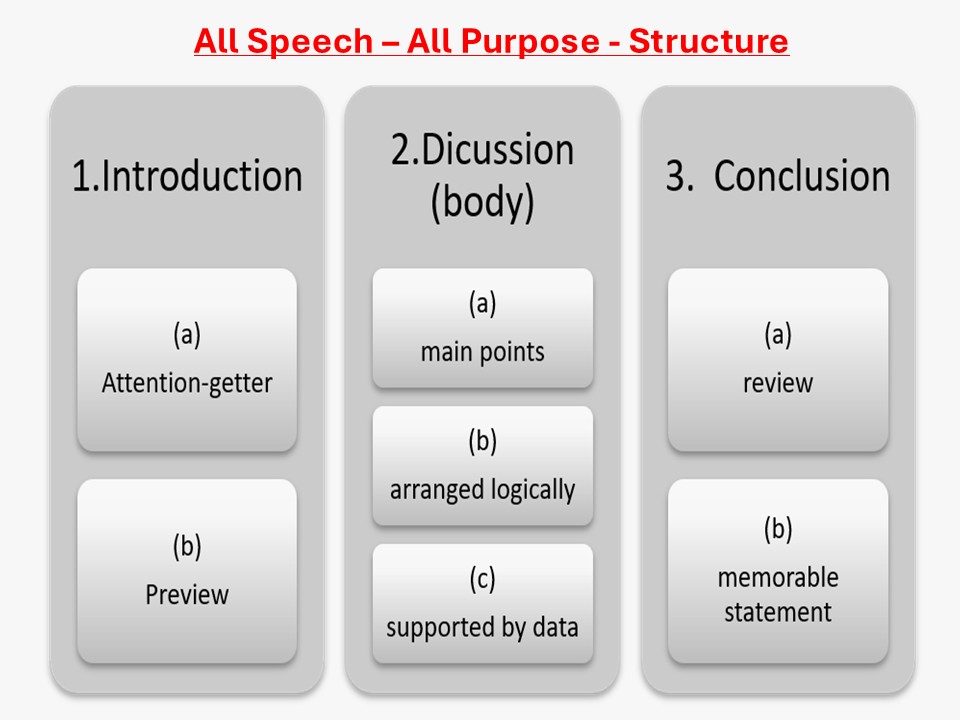
Graphic displaying the introduction-body-ending of the structure of now to organise a speech

Note that it consists of 3 main sections: Introduction – Discussion/body – Conclusion.

That’s because, all good speeches, regardless of the length, will contain these three elements.

Yes, you’ve heard speeches that seemed to have started in the middle and rambled on without end. I’ve heard them too but I have delivered none myself and if you ever did, you’re not going to do that again.

Now let’s briefly discuss the elements of the structure.

Step #4: Prepare the body/discussion of the speech

When you deliver a speech, you start with the introduction.

On the other hand, when you organise a speech, you start with the middle or body.

There are 2 main reasons for this: 

  1. It contains most of the content of your speech – It seems logical then, that you should begin by concentrating on the most important part of the speech.
  2. It’s easier to design the introduction and plan the ending – Consider finding an appropriate attention-getter or preview for a speech you have not yet written. It’s like having to introduce a speaker you have not yet met.

1. Prepare an outline first

As most speakers organise a speech, we find it best to prepare an outline first instead of writing out a full text. You should follow our lead.

Even though full sentences are not needed in an outline, you should still write some specific details instead of wide, sweeping statements.

To give you an example, let’s pretend that mainland government is planning to build a police station on a small island just off its north coast. You are asked to write make a presentation sharing your thoughts on the matter.

Your outline could look something like this:

Topic: Mainland Government’s Plan to Build a Police Station on Speaker’s Island

      Main Points

  1. Cost too much – US$1.5m
    1. More than cost of all the stations on mainland
    2. More than cost of all the stations on the 5 surrounding islands in the last 2 years (US$1.1m)
  2. Not needed
    1. Island had 4 crimes in the last 3 years
  3. Money better spent on mainland education
    1. Only one high school
    2. Population increasing (20% in last 5 years)
    3. Hospitality training needed

2. Arrange your main points logically 

 It’s not enough to outline your main points and submit your name for national honours.

Remember we said that a speech that is well structured allows your listeners to accept your ideas, remember what you said and take the action you want?

Well, there are 4 main patterns you can use to logically arrange your speech, namely:

  1. Time
  2. Space
  3. Topic
  4. Problem-solution

Let’s look a bit at each one.

The Time pattern presents your points in the sequence in which they (should) occur. It usually works best if you’re talking about how to do something, about an activity or historic event. Eg:

  • Past – present – future
  • Before – during – after
  • First – next – last

You wouldn’t go on a trip by packing and then checking to see if a flight is available? Would you? Neither would you install the roof of a house before the foundation. Would you?

The Space pattern organises your speech on the basis of some physical or geographical sequence. E.g.

  • The labour problems in the construction industry
  • The plight of men in the local fishing industry
  • The woes of member countries of the European Union

The Topic pattern is a “catch all” or flexibility pattern which allows you to just list a series of statements and provide the information. It fits any subject or speaking situation so, as you can guess, it’s used more than any other pattern. BUT…

  • The points often lack focus and connection
  • It’s not very creative/interesting
  • It’s not very memorable

The Problem-solution pattern is extremely useful for proposing a change, trying to get something improved, offering a new idea or recommending a plan of action. When well constructed, this pattern can be very effective. Just remember to state the problems clearly and offer solutions in the same order as the problems were presented.

Step #5: Design a hot introduction/opening

Yeah…Why not? The introduction is where the magic happens. If you don’t nail it, you’ll have a hard time connecting with your audience and someone will have a hard time moving your vote of thanks.  

Notice that the introduction comprises an attention-getter and a preview.

Let’s go a little deeper into both of them. 

The attention-getter

What is an attention-getter? Very simply, it’s a means of of getting the audience’s attention and connecting with them almost immediately.

This must not be confused with the greeting. You know, the “Mr Chairman, Madam Guest Speaker, Distinguished Members of the Head Table…” That’s the greeting NOT the attention-getter. 

The attention-getter comes right after the greeting. Or if you’re a hot, in-your-face, “lots-of-attitude” kind of speaker, you can deliver your attention-getter and then the greeting.

In the table below, I have selected 10 of the most popular ones for you, give you examples and make valuable comments to help you.
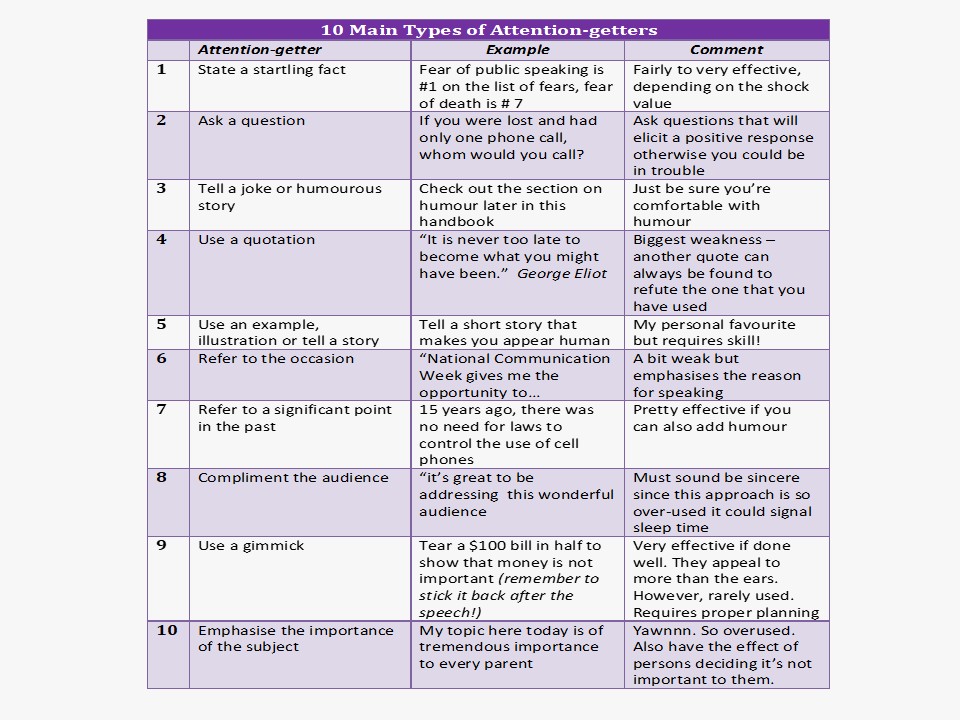
Graphic displaying the main types of attention-getters to help you organise a speech

The preview

So you have your attention-getter and you want to make a smooth transition to the body of your speech. That’s the job of the preview.

The preview is a clear, specific, precise statement of your speech subject and ought to be no longer than a sentence or two.

Here is an example of how they work together. This was the opening of an introduction I did for a prominent gentleman in my country:

“Who the cap fits, let them wear it…And if it feels good keep it on!” (attention-getter)

“Mr Chairman, Madam Guest Speaker, Distinguished Members of the Head Table…” (the greeting)

“Mr X has worn many hats in his lifetime and he has worn them well. But today he’s wearing his leadership hat as he speaks to you about “The Joys and Pitfalls of Being a New Leader”. You will walk away with…” (the preview)

People are still talking about that introduction even though it was many years ago..

Step #6: Plan a meaningful ending

How you end your speech is as important as how you begin it.

Therefore, in organising a speech, you have to plan a meaningful ending.

Sticking with the All Purpose – All Speech Structure which I shared earlier, the conclusion comprises two parts: review and memorable statement.

The Review

There are several ways that you can review your speech. Let’s look at the main ones.

  1. Summarise the main idea of your speechThis is not to be confused with summarising your main points. It is a simple and brief statement of one or two sentences, such as: so now you understand why I believe that sex is not everything…It’s the only thing! 
  2.  Repeat the main points of your speech – In new words or the same words you use in the rest of the speech: Remember watching paint dry stimulates your creativity, it massages the ego, it provides many “aha” moments and sharpens the intellect.
  3. Summarise and repeat together – This approach is very popular and if done well, can still be brief. For example:  So now you understand why I believe that sex is not everything…It’s the only thing. Without it you would not be here listening to me, kings would not have given up their thrones, and you would not know if you are male or female.

 The Memorable Statement

This is the point where you tie up your speech like a special gift and present it to your audience. How do you this? First, plan to be brief.

Then consider using any of the following:

  1. Any of the techniques used as attention-getters for the introduction of your speech – If you began with a quotation, you can use another one that equally supports your point. 
  2. Return to the theme of your attention-getter – If you began with a joke you can retell it with a different punchline
  3. Point to the future – Especially useful if you are using the Past-Present-Future format
  4. Call to action – Mandatory for persuasive speeches
  5. Tie-in with whatever (or whoever) will follow your speech – I especially like this one. E.G. You know that a business meeting will follow your speech. You memorable statement could be something like: As you deliberate in your upcoming meeting, please consider using the 3 main reasons why children should be forgotten at their grandparents which I shared with you, as the basis for a national policy on parenting.

So…Can you organise a speech?

Yes you can…if you got here by the direct route. That is by not skipping any of the steps. If you did, let me recap them for you:

  1. Narrow down your topic
  2. Locate your ideas and information
  3. Determine a structure for your speech
  4. Prepare the body/discussion of the speech
  5. Design a hot introduction/opening
  6. Plan a meaningful ending

Six practical steps to ensure you can organise a speech. 

The same 6 steps I use for my speeches and the same 6 steps I teach my Top Level Speaker clients.

The value in a well-organised speech is that writing it is easy.  And it certainly reduces your fear of standing before and audience and delivering it.

So go ahead, bookmark this post and the next time you have to deliver a speech, you’ll know where to find all the help you need.

Join our weekly newsletter

For useful, practical small business tips & your FREE CEO Mindset Checklist! 

See our privacy policy here.

Subscribe To Our Weekly Newsletter Lorna @ Large

Get useful, practical small business tips & your own FREE CEO Mindset Checklist!

See our privacy policy here.