

Last updated on April 20th, 2026 at 07:18 pm

According to one of my clients: “This does not any sense at all!”
And I understand the sentiment. It’s the same response I get to my other similar piece of advice, “borrow money before you need it…” But trust me, they’re both good business solutions.
But when you are thinking of selecting team members before you need them, you’re demonstrating “big picture thinking” instead of just living in the short term.
When I had a small retail business, here’s how I did it:
This hiring process allowed me to almost seamlessly onboard a new team member as fast as I needed one.
One of the biggest complaints I usually get from clients, colleagues and friends is: “I can’t get my employees to make even a small decision, chewpse!”
A question for you my serious leaders…Will you believe me if I told you that this is your fault?
Before you come after me, let me show you what I mean by telling you a little personal story.
Some years ago, I bought a gym (I had my head examined after!) and decided to keep the existing employees. Talk about the team you inherited…
In 5 short months, I had moulded what everyone told me was a group of misfits, into a dream team that I was really proud of.
A big part of my success was the decision-making process I had established. It was as simple as this:
If a problem comes up on your shift that you know how to solve, solve it. If you can’t, think of a solution before you come to me, and share it with me before you ask for mine.
This was responsible for a tremendous increase in their willingness to take initiative and risks. It also increased their self-confidence and self-esteem as well as their productivity and freed me to make bigger strategic decisions.
Before you rush off to implement this system though, there’s something that you need to put in place.
You need to make sure that you are assertive and strong enough have the confidence to create a “space” in which your staff feels safe to make decisions.
That “space” must be built on support and guidance as opposed to punishment, even when a decision is not the best.
In other words, your staff must be comfortable that a “bad” decision will not result in punishment.
One of the things that small business leaders gripe about is the frequency with which employees are inclined to lie. As a matter of fact, they actually believe you can’t spot a lie.
Instead of laughing and then firing them when you’ve had enough, you should reduce employee turnover and improve team culture by NOT tolerating obvious lies.
They should know that you really CAN connect the dots between how many aunts they had at the beginning of their employment, and how many funerals they have to attend 6 months later, due to the death of aunts.
So, call them out on these lies. Get clear on the behaviour you will and will not tolerate and share it with them.
Heads UP: Do not be guilty of lying yourself!
To reduce the need for these petty lies from your staff, one of the things I advise my clients to do, is to make 1 or 2 personal days per year available to each employee. The only limitations that should be placed on accessing these is having to work for a specified period (I usually recommend a year) and a specific request must be made in advance.
Most small business owners feel pressure to project confidence and competence at all times. They think that’s what leadership looks like. It’s actually one of the most quietly damaging things they do to their teams.
Here’s why it matters so much in a small business:
You are the culture. In a big company, culture is spread over many people — shaped by many leaders, policies, and norms. In your 6-person business, your behavior is the culture.
If you never admit a mistake, your team learns that mistakes are dangerous things and you need to hide them.
However, the problem is that many small business owners believe that admitting to failures means that they would lose authority.
But here’s the paradox: Owners who do this don’t lose authority — they actually gain it. The team stops trying to be perfect and starts being real with you.
And best of all, It connects directly to your position about not tolerating lies — you can’t expect honesty at the bottom if you’re projecting perfection at the top.
Yes, you know that an employee is studying.
Yes, you know when their exams are.
What you did not know is that they would want their vacation, some study leave, any outstanding lunch breaks and any other leave imaginable, just before their exams.
So, they request such leave one week before they need it and then tell you, “You should know I would have wanted it!”
Tolerating this behaviour sets you in the role of “mind reader” instead of “fearless leader.”
In addition, it upsets the rest of the team, disrupts the smooth running of your business and annoys the pants off you. And should you refuse, the employee will believe you’re bad-minded.
Worse than this, it tells me that you are lacking the required policies and procedures that would prevent these situations from happening.
If this is the case, you should put them in place as soon as possible. This would remove any confusion about how to handle these situations and help to make your small business a desirable place to work.
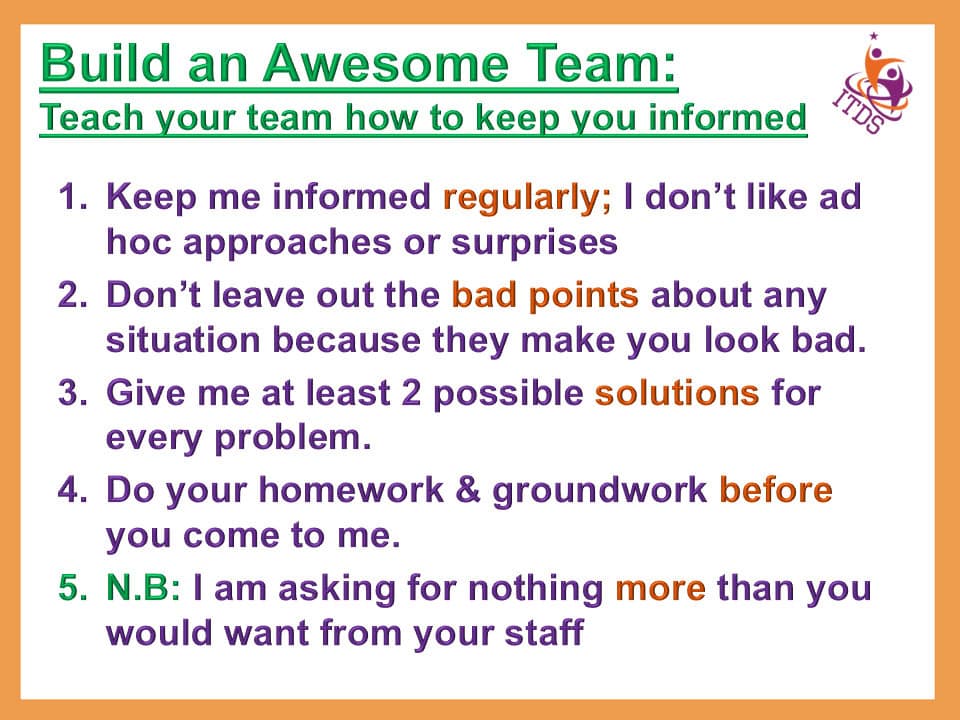
When Business Owners complain about communication problems with their staff, at the top of the list is the haphazard manner in which their staff inform them about many things.
But I usually have one question for them, “Did you give them any guidelines about how to keep you informed?”
The answers generally range from a thoughtful “not really” to a puzzled “no…”
So here is a template to keep you informed that you can ask your staff to use:
If you give your staff even these few guidelines, the communication process becomes clearer and everyone is happier.
Simply put, “sucking up” is when a particular employee tries to get in your good books by constantly complimenting you and attempting to do you favours.
While you understand that, and you’re aware of it, what you do not quite understand is the impact this has on your business, especially the rest of your team.
First of all, according to the Journal of Applied Psychology, this behaviour of sucking up to bosses takes energy employees could be using to do what you hired them to do.
Secondly, most of you are susceptible to this ingratiation and almost imperceptibly, you begin favouring this employee over the rest. Admittedly, some of you are suspicious of employees who behave like this but you don’t quite know how to respond.
The problem with this is that eventually, the “ingratiators” soon becomes a law unto themselves. Then both you and that employee lose the respect of the rest of the staff.
Naturally, this impacts the cooperation and reduces team engagement in your business. And your constant frustrated thought is “I feel like firing the whole lot of them!”
Instead of firing anybody, address the sucking up directly.
Simply thank the person for their compliments and favours but at the same time remind them of the things that would impress you even more. These could include punctuality, being more helpful to other colleagues, completing projects on time, etc.
In this way, you will keep every employee happy and successfully build an awesome team.
When something goes wrong in a small business, the instinct is to find out who caused it. That instinct is understandable but does not serve your purpose as the leader.
You see, the moment your team senses that mistakes mostly lead to blame, they develop a survival skill: self-protection. They hide problems early, explain away errors, and quietly point fingers at colleagues before the finger gets pointed at them.
You’ve now built a team that’s more focused on not being wrong than on getting it right.
The solution: Establish a “no blame” zone.
A “No Blame Zone” is an environment in which instead of blame, employees are encouraged to develop solutions to solve their own problems.
Solutions can also be derived by working with other team members, leading to team-wide problem-solving and increased camaraderie.
You support the zone by ensuring that employees are clear about the bigger picture or vision of the business and how what they do fit in with that vision or mission.
It is important to stress that a no blame zone doesn’t mean no accountability. On the other hand, it does mean that the first question after something goes wrong is always:
“What happened and what can we learn from this?” instead of “Who did this?”
Your decisive role is to create the psychological safety that lets your team operate in the no blame zone.
And when you do, you’re quietly building something special…an awesome small business team.
One of the things that employees appear most unhappy and disgruntled about, is an apparent reluctance by their employers to pay for their professional development.
The truth is, you understand the need for employee development.
What you do not understand is why you are expected to take full responsibility for financing this. Surely they know that you cannot afford this. Moreover, when they leave they take the training you pay for with them.
This issue has caused a lot of unresolved conflict between Small Business Owners and their employees, usually ending with the employees leaving in search of greener pastures.
In order to address this matter effectively, as far as possible, try to partner with your staff on their professional development.
When you think about of it, both of you stand to benefit from this approach. But you need to ensure that any programme of continuous professional develop (CPD) helps your employees to:
When you take this approach, your employees are sure that you have their best interest at heart. So even if they leave eventually, it’s on so much better terms.