

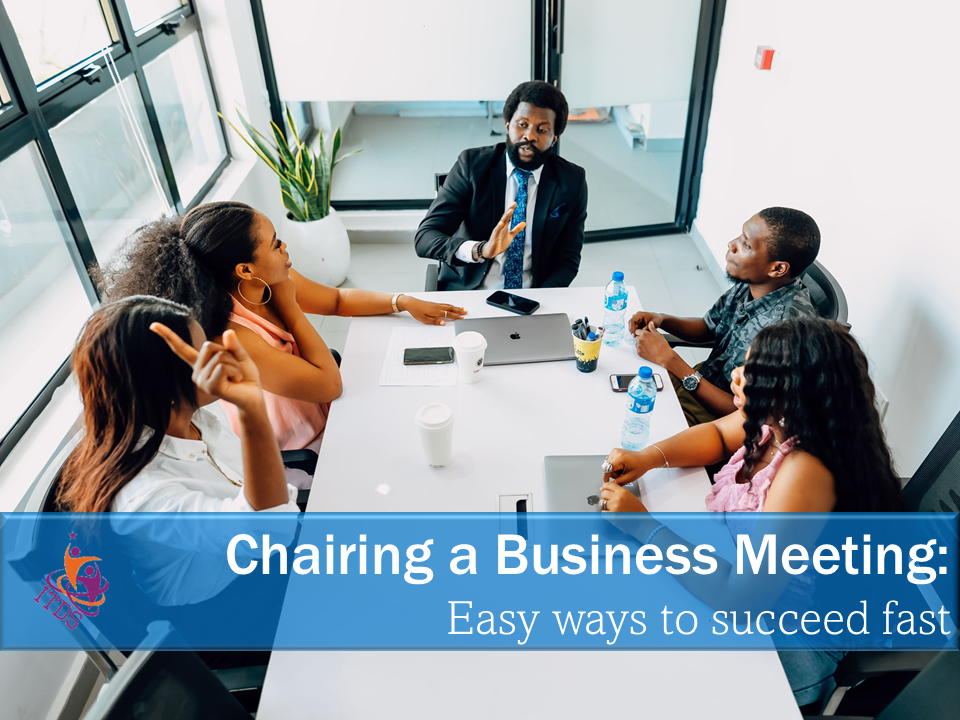
Chairing a business meeting can feel daunting and you want to run and hide at the very thought. (under the bed if you’re like me!) But it is one of those is one of those skills that quietly pays off across almost every part of running a business, especially a small business.
For example: It improves your time management skills; decisions actually get made and you pay attention to the follow through; It builds credibility and authority and it’s great for your own development – all skills and attributes that help you to manage your business better.
This article is primarily for small business owners who want to up-level their chairing skills using tips and strategies they can apply and get results. It’s also for anyone else who needs to be chairing a business meeting.
In particular, you will learn:

For the most part, I agree with the general definitions of a business meeting, which go something like this:
A gathering of individuals, typically employees, stakeholders, or board members, convened to discuss matters pertinent to an organization’s operations, strategy, or governance.
However, what these definitions do not include, are those meetings of associations representing specific areas of business such as Human Resource Management Associations, Small Business Associations or Associations of Corporate Shareholders.
Chairing business meetings of these associations are especially important to small business owners.
It usually means that they have been elected to the position of president, a promotion they would not get in their own business or they have been invited to serve on a committee.
Whichever business meeting you are chairing, to be successful, you need to possess the skills of a great Chair and to deploy these effectively every time.
Chairing a business meeting well turns that meeting from a “waste of time” into a “management tool”. For a small business, where the owner often is the management layer, this is a significant advantage.
Therefore, here are 7 ways you can really upscale your skills at chairing a business meeting…
Seriously though, I have gone to some meetings where I believed I was alternately at the theatre, in a shark-infested swimming pool or at the circus, all in the space of 45 minutes.
Equally, I have been fortunate to attend meetings that were highly productive, well conducted and finished in the allocated time.
The outcome of each meeting was mainly due to the personal attributes and knowledge of the Chair.
Here are some of the personal qualities a good Chair should have:
Authority – the chair will need to maintain control so as to ensure that the meeting achieves its objectives as detailed in the agenda.
Flexibility – means knowing that the meeting procedures protect the meeting’s legitimacy but also knowing rigid formality can stifle a small group. Knowing when to be flexible is the mark of a great Chair.
Effective communicator – includes the ability to be able to speak reasonably fluently, using language that the group can readily understand and should not be bashful about addressing large groups of people.
Decisive – this means being decisive in rulings on procedures, on how matters should be dealt with and also having the tact to deal with all types of people in a fair, firm and courteous manner.
Impartial – the Chair must be able to support an equal and fair consideration of all sides of an argument, even when they are privately in favour of a particular side.
Analytical – the ability to analyse an argument or situation presented to a meeting and make a reasonably fair ruling is an invaluable quality in an effective Chair.
Calm and placid – and be able to deal with explosive situations without ‘losing your cool’.
When chairing a business meeting, the primary focus of the Chair should be the process of the meeting and not the substantive issues it has been called to address.
In other words, your continued effectiveness as Chair will almost always be more important to you an individual and a business owner, than the ability to shape the outcome of any single issue.
So, here are some important duties of the Chair which you should know and practice:
Start and finish on time – Beginning on time shows you can manage time and respect people’s schedules. Ending on time keeps them coming back with good attitudes. And please know that If you wait for latecomers, you punish the people who showed up on time.
Set the ground rules early – Open by restating the purpose of the meeting and how it will run – one speaker at a time, addressing remarks to the Chair, no cell phone use during the meeting, etc. A minute of framing saves ten minutes of drift.
Keep discussion on track – Your job is to guide the conversation, not dominate it. When someone goes off on a tangent, acknowledge it, note it in a “parking lot,” and steer discussion back to the agenda.
Manage contributions to discussion – Invite quieter people to share their views, and politely rein in anyone who talks too much. Some of the best ideas come from people who wouldn’t speak up unless prompted.
Summarize decisions and assign actions – After each agenda item, recap what was decided, who is responsible for each task and by when, before moving to the next item. This not only helps the secretary/note-taker to take clear notes but also facilitates better implementation of decisions.
Know parliamentary procedure – Effective Chairs use parliamentary procedure to keep business meetings moving briskly. The more parliamentary law the Chair knows, the easier it is to accomplish the order of business and earn the respect of the group. See #3 below.
Ensure the rights of all – To do this, the Chair must maintain appropriate behaviour at all times, ruling with tact and decorum, assisting members to accomplish the purpose of the meeting and not allowing any single “personality” to dominate the meeting.
Make effective use of the agenda – The agenda is not only a tool for the conduct of the meeting, an effective Chair should also know how to use the agenda to control the meeting. I have written a comprehensive article on the purposes and uses of the agenda. Access its wealth of information here.

Parliamentary procedure is a set of rules for the orderly conduct of meetings, with Roberts Rules of Order being the authority on parliamentary procedure. If you are serious about chairing business meetings, try to acquire a copy.
Essentially, they help to ensure that the will of the majority prevails while the rights of the minority are protected and at the same time, safeguarding those absent from the meeting.
Here are the 3 things I notice Chairs regularly get wrong when chairing a business meeting:
A point raised against any proceedings or motions that the member believes to be in violation of the rules or the decorum of the meeting. The objection must be raised at the time of the violation.
When a member rises on a point of order, it interrupts the meeting and the speaker who has the floor sits immediately and the Chair asks the member to state his point of order.
If the Chair rules that the member is in order, the violation is corrected immediately. The Chair can also rule the member out of order and allow the original speaker to continue with their presentation.
A request made to the Chair for more information on a matter coming before the meeting. It interrupts the proceedings and the Chair must ensure that the request is addressed immediately.
The Chair can provide the information or ask someone in the meeting with the knowledge to provide it. The Chair should not allow a member to rise on “a point of order” to request information.
This is a request by a member for the immediate consideration of a matter affecting their comfort, safety or personal well-being. This is not a point of order.
For example, if a member finds that the room is too cold, they can rise on a point of privilege and ask for the temperature to be raised. It is up to the Chair with the agreement of the meeting to comply.
Have you ever gone to a meeting and had to ask yourself: “Why is X here?”
Well I have! And before I can answer myself, some more Xs enter the room.
So as Chair, if you have any say in who comes to your meeting, make use of it. This ensures that only those people whose presence is absolutely necessary gets invited. Furthermore, when it comes to productive meetings, bigger is definitely NOT better.
You see, whatever the stated purpose, some people will come with hidden agendas. Your job as Chair is to be able to spot these hidden agendas and have you own methods to address their behavior.
So here are some of the “hidden agenda” reasons some people attend meetings:
So be strong about inviting only those who need to be at the meeting and if you feel that people who were not invited will feel excluded, explain your reason for not including them. Give them a copy of the minutes or a summary of the outcomes.
What is the most important meeting arrangement you will ever make? It is the seating plan. Why? It is psychological and it sets the tone for the whole meeting at the very beginning.
I’m sure you have heard that the optimum seating plan is U-Shape or Semi-circular, if you have the space. This takes care of acoustics, visibility and eye-contact.
But the psychology is in who sits where in that U-shape or semi-circle.
For example, you don’t want to have 2 “enemies” sitting opposite each other on either side of the U. This increases the opportunity for “eye contact” confrontation which you will have to manage.
It’s better to have them sitting on the same side with a couple of people between them.
Then you want to seat a friendly face at the bottom of the “U” so that you know where a friendly or encouraging face is located should the going gets rough.
And what about your one-on-one meetings?
As you know, A one-on-one meeting will normally be called for one of three purposes: (a) to support, (b) to collaborate or (c) to confront.
There is an optimum style of seating for each purpose and if the wrong arrangement is used, it might be difficult for the meeting to follow the path that you intended.
Here are some tips on how to arrange seating for the various purposes.
Occasionally, you might find it necessary to present something new and or controversial to an audience.
When this is the case, you will find yourself chairing a business meeting with a hostile audience. Hopefully, not hostile to you personally, but hostile to your point of view.
When this is the case, you’re said to be “chairing under fire” and your duty as Chair is to defuse this hostility. The following tips will help you:
Whatever happens, do not allow the meeting to degenerate into a mud-slinging competition. If the offenders become unduly disruptive, as a last resort, have them removed from the room.
So there you have them…Just 6 ways to get you up and chairing a business meeting fast.
Let me remind you of them:
When you master these, you create the foundation for being a competent chair and place yourself ahead of many other people who have to chair meetings. In addition, you move your meeting from the level of “free for all” to a successful decision-making tool.
Embrace them and use them when you have to chair meetings and build your reputation as a person whose meetings are worth attending.
For useful, practical small business tips & your FREE CEO Mindset Checklist!
See our privacy policy here.
For useful, practical small business tips & your FREE CEO Mindset Checklist!
See our privacy policy here.