
Last updated on September 17th, 2026 at 11:09 am
Among other things, this post covers:
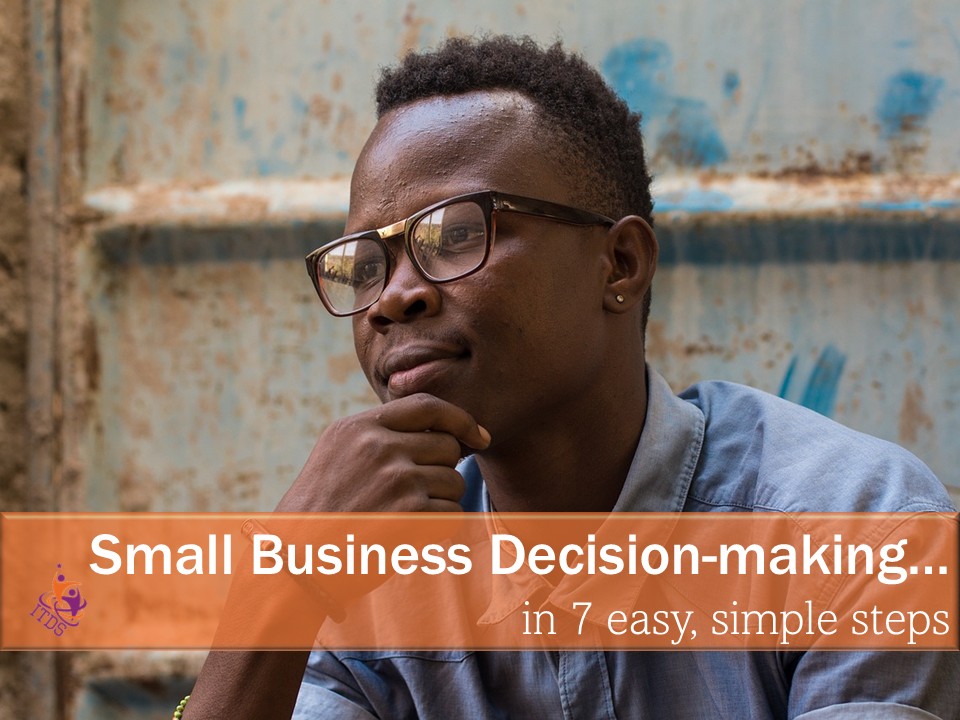
Small business decision-making, by its very definition, should not be the victim of big business processes or methods.
In other words, to ask a small business person to follow the complex methods and multiple steps big business use to make decisions, is like using a sledge hammer to kill a fly.
Therefore, like many things “small business,”decision-making must reflect the special needs, circumstances and unique context of small businesses.
That’s why I created this easy, simple but effective 7-step method which small business owners can use to make smart decisions.
But before I discuss them, let me ask you…
I know when I am procrastinating but sometimes I hate when I have to make decisions. (Relax, I am human too!)
But when my phone rang and on the other end was my fave business colleague and friend, inviting me to “a quick power lunch,” in a flash I made my decision. Lunch it was!
I know there’s no such thing as a free lunch.
If you do too, you can understand why I was not surprised when no sooner had I ordered my meal, he dropped his little confession:
“If you don’t mind, Lorns, I invited you here to ask you: what is your secret for making decisions?” how do you do it?
“I mean…look at the way you just decide on things and implement them in your business and in your life…me I have to go all the way around the world and back and still can’t seem to make the decision…”
So…I invited you to lunch to ask you if you can give me some tips…even a few…on the smartest way to make decisions…especially for my small business…
No problem, after all lunch was on him…
But I have to ask you…How do you make decisions? Are you like my friend? Do you hate making decisions…especially those that impact the people in your business?
Or do you make decisions quickly, mentally prepared to “suffer the consequences?”
Maybe it can help to know that however you make decisions, there are so many other people making them just like you…
But I know it will help even more, if I were to give you my simple, easy 7-step decision making process, which you can follow to make smart decisions in your business…
So without any fuss and no drum rolls, here are the steps that make up the process:
Let’s be clear what is a skill:
A learned ability to do something, (eventually) with a high degree of competence, to the extent that when you apply it, you achieve the intended goal or outcome successfully.
You can also check out this post about 12 secret entrepreneurial skills,
If you embrace decision-making as a skill, you will realise that like all skills, you can learn how to do it and get better at it with practice.
On the other hand, when you avoid making decisions you are behaving like an athlete who is not turning up for practice but expects to win the tournament.
In this case, both you and your business will suffer if this is the approach you bring to decision-making.
So begin with the mindset that it is a skill. And you can master it.
A good way to begin practicing this is by making small, simple decisions as they are needed, without procrastinating. This builds your confidence and lays the foundation for you to make increasingly bigger decisions.
It is common practice to focus on HOW to make a decision.
But for small business people, I have come to recognise that the “WHY” is equally important, even if it is not always clear.
Let’s look at a scenario to show you what I mean.
“Cyril” needed to buy a new vehicle for his small plumbing business. It was a foregone conclusion by his wife and small staff that he would buy some sort of small pickup truck.
No one could understand why Cyril bought a Sports Utility Vehicle (SUV)! Except his friend who had convinced him that the SUV could kill 2 birds with one stone – transport his plumbing things and go off-roading with him on weekends.
Among small business owners, this is not as far-fetched as we would want to believe. That’s why knowing your “why” is so important.
Creative Content Marketer Sandy Norman discusses “Determining your why for purpose driven decision making” and I require my clients to engage in the “5 rounds of why is this important” exercise. It works like this:
First you state the problem. Then you begin a series of “Why is this important?” questions. Usually you get certainty about your reason in 3 -5 rounds of questions, if you answer them sensibly.
So using Cyril’s example:
Problem: There is need to buy a new vehicle to transport plumbing supplies and equipment for the business.
Round 1 question: Why is it important to address this?
Answer: There is need to reduce the current high maintenance costs of the existing vehicle and a bigger vehicle can accommodate more items in a single trip.
Round 2 question: Why is it important to reduce these costs?
Answer: To divert funds from constant maintenance cost to increase cash for investing.
Round -3 question: Why is it important to have money for investing?
Answer: For example, to replace existing obsolete vehicles with ones that improve the operations of the business.
At this point, Cyril would have had clarity on his “why” had he engaged in this exercise. And his friend would have had great problems encouraging him to buy an SUV.
Notice you do not have to go all 5 rounds to get certainty about your “WHY.” Also, please note that your answers might be more expansive than this example.
Intuition, especially feminine intuition, can certainly inform the way you make decisions.
As a matter of fact, there has been considerable research into the role of intuition in decision-making with American Administrator and Author, Chester Barnard, as early as 1938 remarking that:
Business managers often do not have the luxury of basing their decisions on orderly rational analysis, but depend largely on intuition or judgment instead.
But you must combine this with your business experience so that you make decisions that are right for your business.
Let’s face it. Our intuitions are sometimes wrapped up in our emotions. And if we are not in a good place emotionally our intuitions can be equally off.
For example, let’s say you want to borrow money from a bank. But instead of following the instructions the Loans Officer gave you to complete the documents, you decide to ignore them.
On the day of your appointment, you walk into the bank and with all the confidence in the world, you inform the Loans Officer that your intuition tells you that you will get the loan.
How do you think that will work out for you?
Incidentally, is this or some similar attitude your approach to getting finance for your business? Then your negotiation skills must be very strong.
What you really need to do is collect as much RELEVANT information as you can about the situation you want to make a decision about. When you review it, you might find that some of the information overlaps and some differ.
At this point, you can use instincts or gut feelings to fill the space where the information is unclear, especially if you need to act fast.
You will be wasting your time if you try to convince me of the following:
You’re past 25 years of age, you have started a business and you’re successfully making decisions and carrying them out, with no thought of the consequences.
If you think that you can make decisions in and for your business without first considering all the angles, trust me, you will not be successful in business for very long.
Thinking of the consequences of your decisions is a big part of how you should make decisions.
So here’s a structured way to do it:
Grab some good old- fashioned pen and paper. Write the decision you want to make at the top. Divide the rest of the paper into 2 columns, heading one “positive consequences” and the other “negative consequences”.
After you have written down the decision, consider as many of the positive and negative consequences as you can, and write these down as well.
Here’s some advice for you.
Remember that with a small business, the separation between the business and your personal life is somewhat blurred. Therefore, if a decision will have a personal consequence, you cannot ignore it.
Therefore, if a consequence is “my partner will leave me” you should not be afraid to write it down. (Far be it for me to tell you in which column!)
When you are clear on the consequences, you will trust your decisions more and be more willing to implement them.
And most of the other formal, structured decision-making models. They are not quite right for your small businesses.
I can say this because I had to study several of them to pass many business courses. I also used them in another life when I worked for fairly big organisations.
So I can confidently admit, they work well for those situations.
However, when I went “live” in my small businesses, it was common sense, business experience and practical approaches like the one describe at #4 above, which helped me to make really good decisions.
You see, small business people seldom have the data to build a decision tree. Then, they are fairly static animals. For example, if your business rules have to change constantly to respond to customer behaviour or your cash flow, then a decision tree will not help you.
As we like to say in our house: as decision-making goes in small businesses, decisions don’t grow on trees.
You can follow our mantra.
Deciding not to decide should have no part in any decision-making process in your business.
As an approach or a step, this is ever so much Bovine Feces! (BF) What if you have a crisis?
In the face of uncertainty you can delay your decision (not forever!) but deciding not to decide is outright procrastination. It’s not a business solution.
Know that you’ll be wrong sometimes.
Trying to make perfect decisions is paralyzing.
Instead, aim to make good decisions with the information you have, using the foregoing tips I have given you, knowing you can adapt as you learn more.
Furthermore, not making decisions when you need to can be as habit-forming as making decisions as necessary.
Please do!
To me, decision-making is a linear process it is not a loop.
When you have a decision to make, don’t keep going around in circles like a dog trying to catch his tail.
This will leave you trying to catch YOUR tail, when your behaviour places your business in trouble.
And don’t try to run it by too many people either.
Getting too many people involved will not necessarily lead to a better decision. As a matter of fact, this could result in your not making a decision at all!
So when it’s time to make the decision…just make it!
The sooner you make the decision, the faster you can correct it, if it proves not to be the one that will work best for you.
When you adopt and practice the 7 steps above, making decisions will become easier and faster for you and you will make smarter, lasting decisions.
I use them all the time.
For example, when my friend invited me to lunch, it might appear that I made that decision quickly. But here is how it went down:
My intuition told me he wanted something but because I know it’s hard to access his time, my motivation was not the food. (Steps 3 & 2)
I could not decide “not to decide” because I wanted to access his high-end clients, even though I know as a consequence, I would have to “burn the midnight oil” later. (Steps 6 & 4)
So very quickly, because I have lots of practice, I easily made the smart decision to have lunch with my friend. And I did not even use a decision tree! (Steps 7,1 & 5)
And I have no regrets!
So there you have it…a simple, practical system you can use when you have to make decisions.
You can use it for simple or complex decision and even big and small ones.
Now that you have read this entire post, you now have a simple, practical approach to decision-making and NO excuse for procrastinating.
Let me remind you, simple as they may seem, these steps work, especially if you are inclined to procrastinate when you have to make decisions.
Take them and make them work for you. You business will grow and you will make a big impact!
Would this system make your decision for you? Not really.
But you have the security of knowing that you have employed a process that could lead you to the right one…more times out of ten.
To your decision-making success…

For useful, practical small business tips & your FREE CEO Mindset Checklist!
See our privacy policy here.
For useful, practical small business tips & your FREE CEO Mindset Checklist!
See our privacy policy here.