Last updated on February 25th, 2026 at 02:22 am
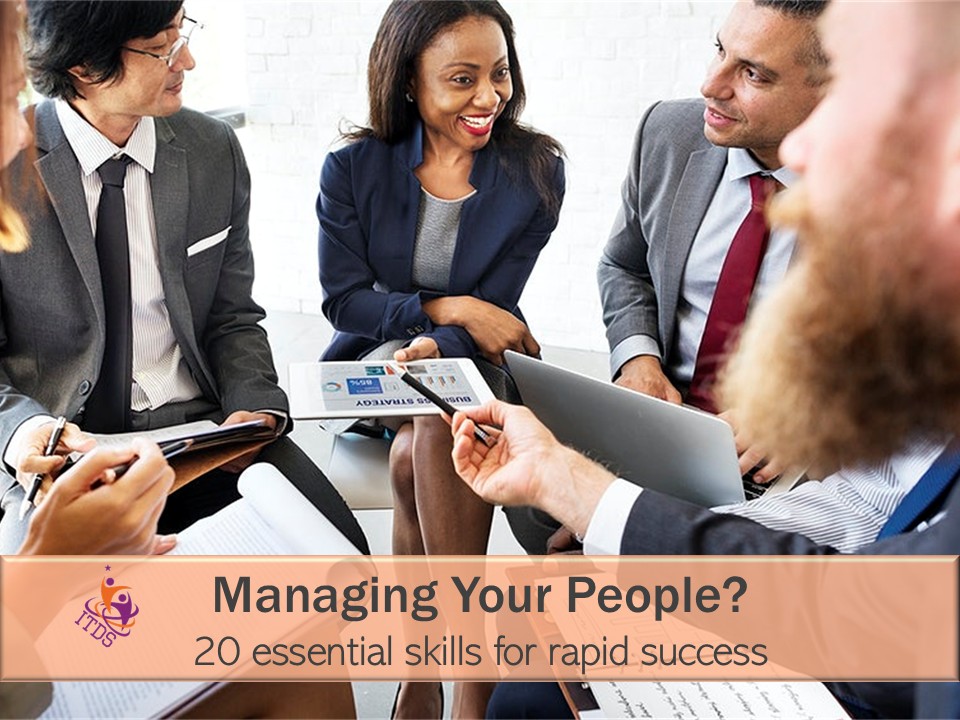
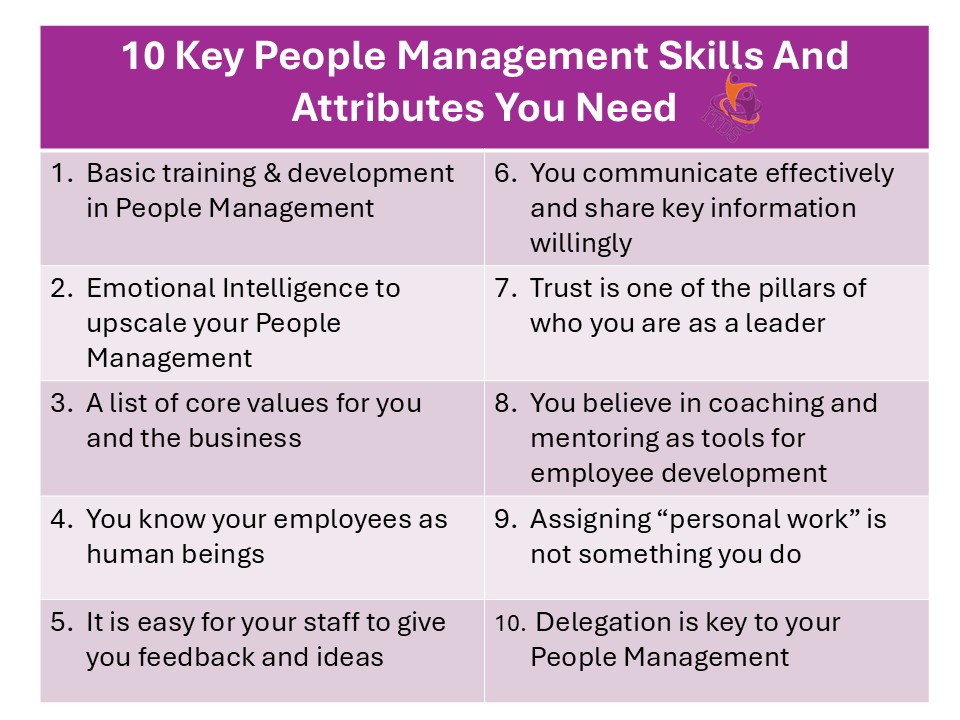
These represent the very basic human resource skills and attributes which you must master if you’re to achieve success fast. They are individual to you the leader, and you cannot outsource or delegate them.
Yes, I know you set up your business to make money, not to be concerned with all this training and development “thing.”
But even if you have a manager or supervisor who is responsible for HR, as the overall leader of the business you need to have some basic training or coaching in this area.
When you don’t have this training, even if you hire someone to handle your People Management issues, you are in no position to understand what they are doing.
Therefore, you would not be able to provide meaningful guidance as needed.

Especially so, when you have to run all aspects of your business, constantly making decisions on the fly.
You will find it’s awfully hard managing your own emotions far less those of other team members.
So it’s one of those People Management skills you would want to tick-off on the checklist.
Just to remind you, values are standards of behavior which define how you live and work.
They are what you stand for and inform what you will and will NOT do.
When you’re managing and leading people, they need to know where you stand and what you stand for.
The important thing about values is that values exist whether you are aware of them or not.
I can’t choose yours for you but here’s a sample list of values to get you thinking about yours.
But whether they are chosen or allowed to evolve on their own, your employees will be aware of them and respond to them accordingly.
I’m not asking you to be friends with your employees or to be their counsellor or therapist.
I’m just asking you to recognise that they are real human being with real lives, who show up in your workplace almost everyday in a year.
You may be inclined to wonder: Why should I know that my supervisor has an ailing mother and that my cashier is going through a divorce?
Well…first, it gives you the opportunity to connect with them at a deeper level and show them that you understand and care about them.
Then it also allows you to readily respond to any related request for assistance they may have.
Feedback is a barometer to the “rightness” of your actions while good ideas help to solve problems.
When you have the confidence to accept these from your team members and act on them, it keeps your business growing and surviving.
It also helps your employees to feel valued and willing to increase their productivity.
But quite unknowingly, many of you small business owners do not even realise that you prevent your staff from willingly sharing those ideas.
When you combine poor People Management skills with poor time management and bad prioritising, good ideas are ignored and the whole business suffers.
I know you’re tired of hearing about communicating effectively…but not many of you even come close to getting it right.
This is concerning because no authentic leader can manage their employees without effective communication, especially in a crisis.
However you define it, effective communication is very much about building relationships with your employees, customers and suppliers.
Because it’s so important, here’s a short, fun video (less than 5 minutes) that explains workplace communication…well so effectively.
Following on from #6 above, you create trust at an individual level whether it’s with your employees or your customers or clients, primarily by the way you communicate.
In addition, trust is not only a part of who you are as an authentic leader, in this 21st century, trust is a tangible business asset.
So, let me remind you about some of what trust looks like in your business.
You engage in open and transparent discussion and when you speak, it’s from the heart and you have no hidden agenda.
You listen more than you speak and you are sure to let the other person know that you value the feedback you’re receiving.
This is not only good for managing your people, it’s just good for business…
Coaching and mentoring are used to enhance the performance and learning ability of your team.
It involves giving feedback, providing motivation and improving communication skills.
The benefit of this approach is that it facilitates your employees being coached and mentored to take responsibility for their own learning and development.
This creates the environment for the employee to learn and grow.
And best of all, you don’t have to do it yourself, you can outsource.
And I will allow you a double tick on this one, if you recognise that you need coaching and mentoring for yourself.
“Personal work” is when you have an employee who consistently do favours for you.
They include favours like like paying your bills, dropping your children to school or picking up your partner from the hairdresser.
The reality is, these relationships create a lot of conflict in a business and is a serious “human resource” issue.
Here’s what really happens.
This employee soon becomes a law unto themself.
Even when he has a direct supervisor, the working relationship is directly between him and you, the boss.
This usually means that it is a waste of effort for a supervisor to complain to you that this employee’s performance is not up to standard.
Naturally, other staff members are disgusted by this relationship.
And they are especially resentful when they have to perform his duties while he acts as your personal assistant.
It’s bad news for how you manage your people if you tick this box.
Delegation is primarily about entrusting your authority to others, enabling them to perform certain tasks and solve problems independently.
The big benefit to delegating is the development that takes place.
The person to whom you delegate, moves beyond following instructions to decision-making and problem-solving.
You demonstrate that you know how to trust, develop your human resource and really understand how leadership works.
In other words, your team assumes responsibility with you for specific tasks – but if something goes wrong, you remain accountable since you are the leader.
You need to tick this box.
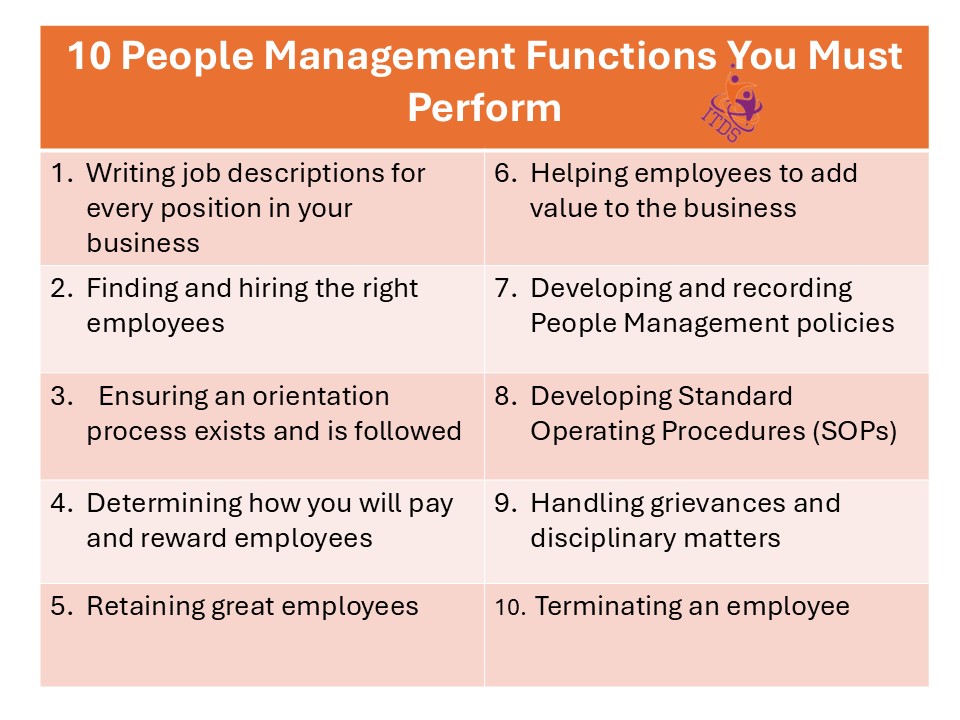
So I have shared 10 key skills and attributes which you should have in your People Management toolbox.
You will agree that’s it’s only fair to you to match these with the 10 functions which you have to perform (or have performed) to complete your competence.
I have numbered these as 11-20 to reduce numbering conflict and set up a checklist of 20 thing for you to tick off.
Let’s get right to them.
This has to be #1 on your list of People Management functions.
Not only is it a sensible first step to hiring but it also helps you to become very clear about the jobs you will need to fill.
Moreover, when there is a dispute about performance, the job description will be an objective tool that can help to settle it.
Now, are you prepared to back these by performance standards and regular performance evaluations?
Or will your evaluations consist of “I ain’t like how you working, hear!”
I’m sure you know that finding the right employees is important. But finding them is not enough…you have to be able to hire the best ones that you possibly can.
That’s why most of the People Management books you will read will deal with “hiring right”.
How do you manage this function? do you use qualifications, experience, skill, personality or some combination of these?
Or do you outsource the function to a service provider who looks after these issues for small businesses?
A good approach is to be very clear about the type of person you want to fill a job, recognising that that job can change in the future.
Can you imagine writing job descriptions and hiring the right human resource and then not having an orientation process?
If you can, I can’t. Why?
I’ve seen exactly what happens when there’s no orientation process and when there’s one.
You see, the purpose of an effective orientation is to make the employee feel like a part of the team.
When they understand goals and expectations this leads to early commitment and increased productivity.
Whatever the size of your business, it can benefit from a 3-phase orientation process.
Call me out if I’m wrong, but how you will pay and reward your employees is high on your mind, when you start your business.
Yes…you know you have to pay them. But HOW will you pay them?
Statutory minimum wages? market rate, above market rate or between statutory minimum and market rate?
Will you pay by the hour, the week or by performance? Or will you just let them take home products at the end of the week?
Knowing or not knowing how you will pay and reward your employees goes straight to your bottom line.
Another one of the functions you need to tick off in your top 10 HR functions is retaining talented employees.
This is not the easiest thing for a small business because we know that your options are limited.
This makes it even more important that you implement a process to retain them.
So have you thought about how you will do this:
Above average pay? Offering substantial benefits? Sharing your vision for the business and encouraging them to grow with you?
Or will you just tie them to a post until you need them?
Jay Forte, writing for mindflash.com seems to suggest that employees are solely responsible for adding value to a business.
I don’t agree.
There are many ways an employee can add value to the business.
But even then, you have to create a culture in which they can share ideas and knowledge willingly and freely. Otherwise, it just won’t happen.
You have to provide the training and development programs to help employees do their work better – even when your training budget is small.
You also have to create the right circumstances for them to quickly learn company policies and procedures, as well as carry out any new job responsibilities enthusiastically.
Don’t leave it to your employees alone. Know what “added value” means for you and help them to add it.
Do you have an employee handbook so that everyone knows the rules and understands them clearly?
You don’t?
Do you know that not having one could leave you vulnerable if an ex-employee decides she has cause to sue you?
At the very basic level, you can come up with the way you want your employees to behave at work and place these in a simple Employee Handbook.
This is far better than finding yourself in the role of “Fireman” constantly outing employee relations fires.
This is a critical function for managing your people because it protects your business, especially if you’re an “absentee” owner.
Standard operating procedures (SOPs) are written, step-by-step instructions that describe how to perform a routine activity.
They ensure employees can complete this activity in the same way every time, so that your customer service delivery can remain consistent.
The popular thinking though, is that SOPs are for big businesses or businesses involved in the production of product.
But this is not necessarily the case.
For example, you can have an SOP for ensuring that keys and equipment are handled properly.
Believe it or not, simple as this seems, it can streamline processes and even save you money.
In its simplest form, a grievance is when an employee feels disgruntled or conflicted about something in their working lives.
And really, it could be in a variety of areas. Check out the short list below:
This list on its own should signal to you that establishing a grievance handling procedure is an important People Management function.
It also has to be well-managed and carefully followed, since it has the potential for the most fall out and biggest possible cost to your business.
Just like handling a grievance, terminating an employee must be one of the key functions you handle professionally and carefully in your business.
It should be done as outlined in your Employee Handbook.
Oh! and let me remind you that “go from around me!” is not a tool for terminating an employee.
Actually it’s really a direct route to a law court.
And also, be sure that you know the difference in meaning and procedure between laying-off and terminating an employee.
If you don’t, you may be comforted but surprised to learn that some businesses, which are bigger than yours, do not know either.
So…how did you score? A perfect score? 18 out of 20? Barely scraped a pass?
If you did not do very well, do not despair.
You now have 10 skills or attributes you must have and 10 functions which you must ensure are carried out in your business.
I’m sure that places you in a better position than when you started reading this post.
So what do you do next?
If you’re still thinking that you are doing just great without People Management functions or skills, wise up right now!
Your human resource IS really your greatest resource!
Therefore, your people need to be managed carefully and skillfully such that they help you to reduce costs and or increase revenue.
This in turn will help you put money in the bank for a long time.
So how do you get really good at managing your people?
Well, you need to get really serious about what skills you’re lacking and which functions you’re not performing.
Then decide how you’re going to tackle improving them, both in the business and in yourself.
Above all, don’t be afraid to get help if you think you need it.
Wishing you success in managing your human resource…