
Last updated on February 25th, 2026 at 02:19 am
While both men and women in business experience imposter syndrome, research shows it tends to affect women more often and more intensely than men.
The reality isn’t that men don’t struggle — they do. But the specific ways imposter syndrome shows up for women are shaped by real, external factors, not just internal doubt.
Let’s take a look at some of these ways…
This is important.
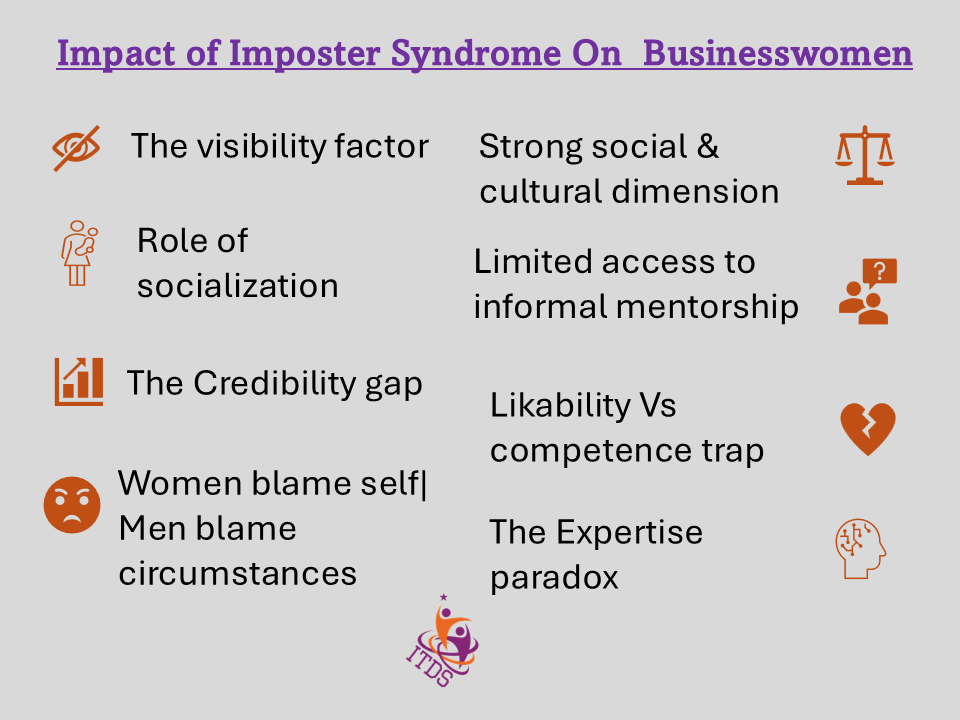
Women in business, especially in certain industries and at higher revenue levels, are still significantly outnumbered.
When you’re one of the few women in the room—whether that’s a pitch meeting, an industry conference, or a business networking event—it’s easy to feel like you don’t quite belong, even when you’ve earned your right to be there.
This pressure intensifies the fear of being “found out as a fraud.”
Many women are raised to be modest, to not “brag,” and to prioritize collaboration over self-promotion. And depending on your age, you were probably also raised to defer to men.
But entrepreneurship often requires the opposite—you need to sell yourself, your vision, your capabilities.
This can create an internal conflict where the very behaviors needed for business success feel uncomfortable or inauthentic.
Studies show that women entrepreneurs face more skepticism from investors.
First, they are asked different types of qualifying questions – more about possible risks versus achieving profits. Then they are still likely to receive less funding even when their businesses perform as well or better than those of men.
So even after succeeding, many women feel like they have to keep proving themselves over and over.
Think about it, when you’re constantly having to prove yourself more than your male counterparts, it must reinforces that nagging voice that’s already saying “maybe I’m not good enough.”
Women often feel they need to be over-prepared and have every answer before stepping forward. Men are more likely to “fake it till they make it.”
Research shows a woman might hesitate to pursue an opportunity because she meets 8 out of 10 qualifications, while a man will pursue it while meeting just 6.
This is really widespread and shows up in many forms.
When I worked in the non-profit sector, I could never get over the ease with which a man would stand up in a conference, put his hands in his pockets and deliver a load of bovine feces. Many times it left us women wondering if we really new what we knew.
It’s not purely an individual psychology issue — it tends to be amplified in environments where someone feels like a visible minority (whether by gender, background, age, or anything else).
The feeling is often shaped by genuinely not seeing people who look or think like you in a given space, which makes it less about irrational thinking and more about a rational response to real social cues.
When women are assertive or confident, they sometimes get labelled as “aggressive” or “difficult” — labels men seldom face for the same behavior.
So women can feel caught: act confident and risk being disliked, or downplay achievements and fuel imposter syndrome. It’s exhausting.
A lot of business learning happens informally — golf games, after-work drinks, casual conversations.
Women historically have had less access to these spaces, which means less informal support or mentorship, fewer behind-the-scenes tips, and more feeling like they’re figuring it out alone.
The reality of this always bring a derisive smile to my lips. When something goes wrong, women tend to think “I wasn’t good enough.” Men are more likely to think “The timing was off” or “We didn’t have the right resources.” This means women internalize failure more personally, which feeds that imposter feeling.

We are in no doubt that imposter syndrome is when you succeed at something but still feel like you don’t deserve it — like you’re fooling everyone and someone will eventually “find you out.”
The inherent nature of entrepreneurship make it profoundly common among entrepreneurs. But it doesn’t mean you’re actually bad at what you do. It does means your inner voice is out of sync with reality.
So here are some practical things you can do to help you navigate this complex circumstance and still succeed:
Every time something goes well — a happy customer, a problem you solved, a goal you hit — write it down and save it. When the doubt creeps in, just review that file. It’s hard to argue with evidence. This turns a habit of focusing on what you got wrong into a habit of seeing what you got right.
When a friend tells you they messed up, you don’t usually say, “You’re a fraud.” You say, “It’s okay, everyone makes mistakes.” Start doing that for yourself. This isn’t about being fake or overly positive — it’s about being fair to yourself.
When the doubt hits, ask yourself: “Is this a fact or a feeling?” For example, “I lost one client” is a fact. “I’m terrible at business and everyone knows it” is a feeling. Once you can tell them apart, the feelings lose a lot of their power.
Nobody knows everything. Not even the most successful business people. Feeling like you don’t have all the answers doesn’t make you a fraud — it makes you human. Give yourself permission to be continuously learning.
Talk to other business owners about how you’re feeling. You’ll quickly find out you’re not the only one. When you hear other people say “I feel that way too,” it takes away a lot of the shame and isolation that feeds imposter syndrome.
Supporting #5 above, create your own “Circle of Experience”. That’s a group of “mentors” from across all areas of your life that you can constantly tap into for your personal and professional growth. Be sure to include business people who are further along the path than you are and no-nonsense people who will be honest with you.
One reason people feel inadequate is they only measure themselves against huge, far-off goals. Break things into smaller baby steps. Every small win builds real confidence over time — not just a feeling, but proof that you can do things.
You see other business owners on social media looking all polished successful. You don’t see their struggles, doubts, or mistakes. Their imposter syndrome. Your comparison is unfair to you. Here’s what you’re really doing to yourself: you’re comparing your full story to someone else’s edited version. JUST STOP!!
When someone says “Great job,” don’t immediately say “Oh, it was nothing” or “I just got lucky.” Practice saying “Thank you.” Accepting credit where it’s due is a skill, and it rewires how you see yourself over time.
When the doubt is loud, go back to the beginning. Why did you start this business? What problem are you solving? Reconnecting with your purpose can quiet the noise and remind you that your work matters.
As you concentrate on building your business and operating in your space, you develop blind spots. These are patterns you can’t see, assumptions you don’t question, and of course, imposter syndrome. A good coach can spot these and help you to address them.
Understanding these patterns makes them easier to challenge. Women can: