

Have you ever struggled to differentiate your services?
I know I have. And I bet as Small Business Service Providers, we all have.
When I started ITDS over 25 years ago, the thing uppermost in my mind was:
Lorna Barrow, if you are going to make money by serving better clients, you have to find a way to differentiate your services!
But I had no idea how to differentiate them and I seem to constantly hire the wrong persons to help me.
Learning to distinguish your services is critical in a crowded marketplace.
It’s also an important part of your professional development, as well as another means of establishing a brand called “YOU!”
Now, if you want to differentiate your services, begin by asking:
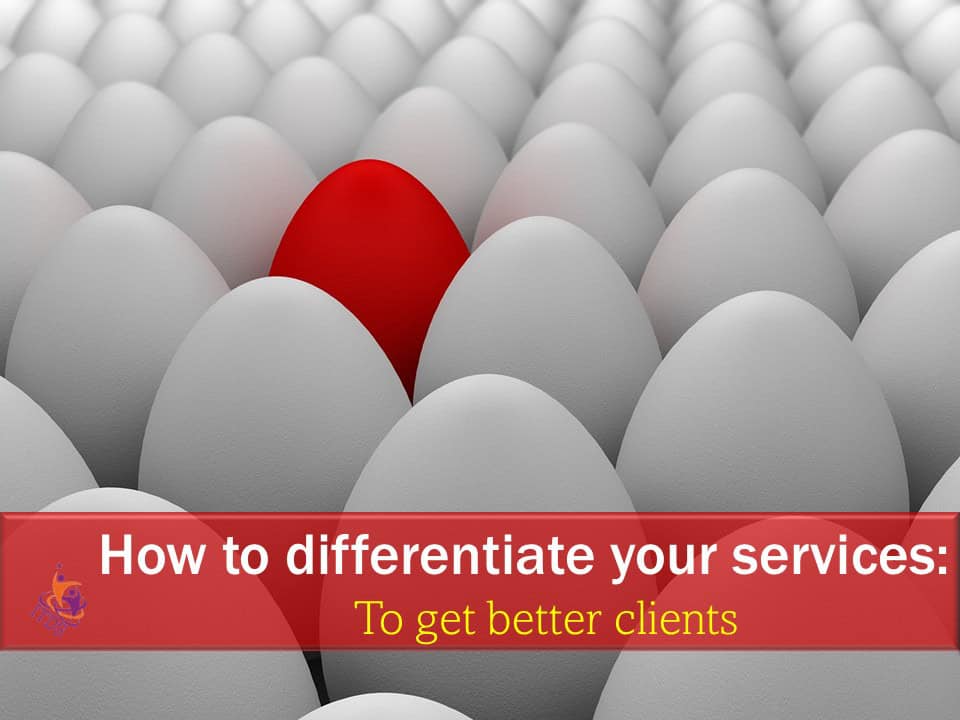
If you want to go high-end with a definition:
Differentiation is the specific, credible reason a client chooses you instead of a competitor who looks similar on paper.
In simple terms:
Differentiating your services means making it obvious — quickly and specifically — why a client should pick you over any other provider, providing the same or similar services.
In other words, it’s answering the question “why choose me and not someone else?” in a way that’s clear, specific, and true.
Your distinction can come from many places:
But the bottom line is, when you are seriously ready to differentiate your services, you cannot be a copy of everyone else in your category or niche. Especially if you’re looking to win great clients.
Now you have to ask:
If you really want to understand why differentiation matters for a service provider, think of what happens without it.
Without it, you can be easily exchanged for any other service provider because the market can’t tell one of you from the other.
Therefore, you can only compete on price and or availability – neither of which attracts good clients.
On the other hand, what if you could compete on any or all of the following methods of differentiation?
Not only will you get clients that are right for you, you will find that they are more ready to buy, therefore the onboarding process will be faster and easier.
Methods or ways you can differentiate your services:
So essentially, when you differentiate your services, here are some benefits you experience:
Now that you have some methods you can use to differentiate your services, you’re ready to…
There are some recognised critical pillars of differentiation for a service delivery.
These are those things that whatever method you use to differentiate your services, they should underpin your delivery.
These include:
So why not determine some pillars just for you and your business?
Here are 3 examples from my business to show you how the pillars might work for or against you:
For example, let’s say that you claim you have a unique way of delivering training.
You cannot then deliver training following the exact methods you and the other 500 participants learnt in the Trainer of Trainers course.
If you do, you do not have a meaningful differentiator and you are not delivering on your claim.
Once, a newly minted Renovations Contractor decided to separate himself from his competition by dressing what he called “professionally”.
In his building renovations niche, his clients were not interested in his dark dress pants and striped shirts.
They wanted him to look like he knew about fixing their plumbing and painting their houses.
This requires you to keep your eyes on trends in your niche or market.
In a sometimes fickle and changing market, what you once depended on to help you stand out from the competition can easily become the norm.
You have to be aware of these trends and be flexible and adaptable enough to find new and different ways to differentiate your services.
Now here are 7 strategies you can use to help you standout in a crowded market place and get better clients. Hint: they work for me and my clients.
Let’s say you’re a small business consultant offering a range of services. Nothing wrong with that. I do too.
But you can differentiate your services by finding that important challenge your clients have – that you can solve.
For example, let’s say you have strong leadership skills as well as equally strong communication skill.
Perhaps you can combine these to create and deliver a leadership program for small business people called Rapid Scale Leadership…that’s what I did.
I know you’re wondering: how is this a differentiator? I didn’t know it was. And I certainly didn’t intend it to be.
But when I started out in business, I was very clear about what I wanted to offer.
When I confidently said “no” to services I was not willing to provide, I was just being honest about what I could do, so I wouldn’t undermine my integrity.
But then I became known for saying “no”.
I soon realized that this was because many service providers were saying “yes” to services they could not adequately provide.
This was making many potential clients skeptical that service providers could deliver the required services.
Hence saying “no” to some things, when other service providers are saying “yes” to everything, is a very strong separator.
The secret is, when you say “no”, your performance on your “yes” services must be exceptional.
This is not as hard as you think.
For me, a niche is:
a group of people, with a common need or problem, which you and and your services can solve.
Therefore, creating your own niche means deliberately narrowing your focus until you become the obvious choice for a specific slice of the market.
The exciting thing about this path to a niche is that it crosses all recognised markets and niches. The emphasis is on the potential clients and not the market or niche.
The fastest path to such a group, following this definition, is often looking backward.
Ask yourself questions like – Which past clients got the best results? Which projects did I enjoy most? Which referrals did I get repeatedly without my asking? When you identify the existing pattern, do some more research and add to that group.
Now make sure your selected niche passes these 3 checks:
There you have it! You CAN build your own niche. And having your own niche is the differentiator of differentiators.
It may be common in your industry to conduct business in a certain way. It could be the way clients are billed, your opening hours, etc.
If you can think of a way to approach doing business that is beneficial to your clients, you have found a way to differentiate your services.
For me, it is constantly recognising what is different about small businesses and devising solutions and ways to implement those solutions, that are ideal for each individual client.
You may think that this is hard to do because to even enter the services market, you have to be prepared to offer great service.
So how can you up your service to outstanding?
It’s really about having the habit of going the extra mile.
For example:
I cannot tell you what that result will be for your business.
But I can tell you that if you can develop it, you will truly differentiate your services.
For example, when I deliver public speaking training, I help the participants build confidence even before they speak.
The result?
It removes their imagined fear of public speaking and the actual public speaking skills are icing on the cake.
In my case, being able to deliver that specific result is an unbeatable selection of my relevant knowledge, skills and experience, combined in a unique way, to solve a series of problems along the way.
This might not be the easiest one for you to try because it involves an element of risk and requires lots of confidence.
Here’s my personal example.
I’m known for my signature jeans in the training room.
No other female corporate trainer has attempted this on my island.
Why?
Perhaps it’s because jeans do not fit the “uniform” for the sector.
But they fit in with my never-fit-in personality, my unique delivery style and my confidence to pull it off.
But the real secret is that when you deliver outstanding service, you can get away with almost anything. Including a distinctive look.
If you’ve not given much thought to differentiating your services before, right now, use this information I share to start now.
Start with the one that you think challenges the most. It will build your confidence and make the rest easy to try.
Just remember when you differentiate your services, especially in a crowded market, you attract better clients and it is good for your brand and your bottom line. It also helps you to improve your role as an influencer.
Now, if you’ve use any or all of the 7 strategies above, let us know how they worked or are working for you.
To your differentiation success…

For useful, practical small business tips & your FREE CEO Mindset Checklist!
See our privacy policy here.
For useful, practical small business tips & your FREE CEO Mindset Checklist!
See our privacy policy here.