Last updated on February 25th, 2026 at 02:20 am

One of the biggest confusions about business coaching is what it actually delivers.
Some people think a coach is a miracle worker who’ll wave a magic wand and fix everything in your business. Others think it’s just glorified cheerleading.
The truth? It’s neither. Therefore, you must be brutally clear about what you’re getting before you invest.
So right here and now, let me use a few examples to help you understand what coaching CAN and CANNOT do.
Business coaching CAN:
What this means: Because you’re close to the business, you develop blind spots. These are patterns you can’t see, assumptions you don’t question, biases that distort your decision-making. A good coach brings the outside perspective to spot what you’re missing.
What this means: You know those things you know you should do but keep putting off? Launching the new service? Hiring that key role? Well, a coach can create structure and systems that hold you accountable and reduce your procrastination.
What this means: You don’t have to reinvent every wheel. A good coach has blueprints, templates, and systems that have been tested across dozens or hundreds of businesses. They can save you months or years of trial and error.
What this means: Experienced coaches have made (or seen) most of the mistakes you’re about to make. They can warn you about pitfalls, dead ends, and costly errors before you waste time and money learning the hard way. Just remember, coaching shortens the learning curve, it doesn’t remove it.
What this means: Coaching isn’t just about tactics and strategy—it’s about who you’re becoming as a leader. A coach can help you develop the skills, mindset, and confidence to make bigger, better decisions and become an authentic leader faster.
What this means: A coach provides guidance, frameworks, and accountability—but we don’t build your systems, hire your teams, close your deals, or implement your strategy. You do! Coaching is about helping you work better, not working for you.
What this means: If your business model doesn’t work or doesn’t even exist, coaching can’t help. When there’s no market demand, your costs vastly exceed revenue or your offer has no competitive advantage, hiring a business coach can do little or nothing for you.
What this means: Yes…business coaches address mindset issues that affect your business—limiting beliefs about money, fear of sales, imposter syndrome. But if you’re dealing with trauma, clinical anxiety, depression, or deep-rooted psychological wounds, you need a therapist, not a business coach.
What this means: No ethical coach can promise you’ll make “$X in Y time frame”. There are too many variables they don’t control. For example, customer service, market conditions, your management capacity, your implementation capacity, your industry, your existing resources.
What this means: This is the most common reason why hiring a business coach fails. You have great sessions with the coach, get brilliant insights, make ambitious plans. And then You implement nothing. (Alright…very little). Listen, information without implementation is just costly entertainment. And coaching is not a spectator sport!
What this means: A coach can help you think through decisions, provide frameworks for evaluation, and challenge your assumptions. But they can’t—and shouldn’t—make the decision. It’s your business, your risk, your life. You have to pull the trigger. Coaching is about you developing your decision-making capability, not outsourcing it.
Coaching is a powerful tool—when used properly, by the right person, at the right time. It’s not magic. It’s not therapy. It’s not consulting. And it’s definitely not a shortcut.

The most important thing you can do to ensure that you get the powerful results you want is to check your readiness to hire a business coach.
That’s why, in this section, you will get a process you can follow to help you make the best decision for you.
So let’s begin with the research.
Based on analysis of coaching outcomes and industry research, there are 3 distinct stages of coaching readiness.
Let’s figure out which one you’re in.
You’re in this stage if:
Your business doesn’t have consistent revenue yet. If you’re making less than, say $5,000/month consistently, you need cash flow and cash reserves before coaching. A coach can’t fix an unproven business model. They can only optimize what’s already working.
You lack clarity on what you’re offering. If you’re still figuring out what you’re selling and to whom, that’s market research and “rinse and repeat” work, not coaching work.
You’re looking for someone to tell you what to do. You need a consultant, not a coach. Coaching isn’t consulting. If you want a step-by-step playbook, you need some kind of training instead of a coach.
You can’t afford it without going into debt. Quality coaching typically ranges from $2,000-$10,000+ monthly. If that would require a credit card or loan, you’re not ready. Build your cash reserves first.
You’re hoping the coach will ‘fix’ you. If you’re looking for therapy disguised as business coaching, that’s a red flag. Yes…business coaches help with strategy, systems, and execution but not deep psychological work.
What to do instead: Focus on getting your first 10-20 paying clients. Read books, take affordable courses, join free communities. Build your foundation. When you have proven revenue and know what you’re selling, come back to this blog post.
This is the sweet spot of readiness.
You’re ready for coaching when:
You have a working business model with consistent revenue. For example, you’re making $10,000+ per month consistently and know how you’re making it. You understand your customer, your offer works, and you’re ready to rapidly scale your business.
You’ve hit a ceiling you can’t break through alone. Your growth has plateaued. You’re stuck at the same revenue level for 6+ months despite your best efforts. In addition, you keep facing the same obstacles.
You’re clear on what you need help with. ‘I need help with everything’ is not readiness. ‘I need to systemize my operations so I’m not the bottleneck’ is readiness. Clarity matters.
You’re willing to be uncomfortable. Coaching will challenge you. It will require change. If you want validation for what you’re already doing, save your money. Research shows that ’embracing change is a fundamental aspect of business coaching.’
You are ready to make time to implement. The typical small business owner works 30+ hours per week in their business. If you’re so underwater that you can’t carve out time to work on your business (not just in it), coaching becomes another item on a list you can’t complete.
You can afford it from operating revenue. You can pay the investment without stress or debt. Remember: 68% of individuals who hired coaches made back their investment, and the average financial gain is 3.44 times the amount spent. But that requires first having the cash to invest.
You’re coachable. You can take feedback without getting defensive. You’re willing to try things that feel uncomfortable. You understand that the coach’s job is to challenge your thinking, not agree with you all the time.
The data backs this up: Entrepreneurs who work with business coaches report 46% higher revenue growth than those who go it alone. In addition, 39% are more likely to achieve their annual business goals.
It seems like one of the favourite pastimes of small business owners is procrastinating around important things. (Me included!)
It’s no surprise then, that some of you would wait too long to hire a business coach.
But how would you know if that’s the case?
Well, you’ve waited too long to hire a business coach if:
You’re experiencing burnout or health issues. If you can’t sleep, you’ve gained/lost significant weight from stress, or you’re having panic attacks about your business, you needed help yesterday.
Your business is bleeding money or talent. High employee turnover, cash flow crises, or losing your best clients—these are emergency situations. You need intervention now.
Major decisions are being delayed indefinitely. That hire you’ve been ‘researching’ for 6 months. The business pivot you keep analyzing but never executing. Analysis paralysis is costing you real money.
Your personal relationships are suffering significantly. Missing important family events repeatedly, spouse threatening to leave, or friends who’ve stopped inviting you places—your business is consuming your life.
You’re stuck in reactive mode 24/7. Every day is firefighting. You haven’t worked on your business in months—only in it. You’re the bottleneck for everything and you know it.
Important: If you’re in crisis mode, you might need immediate intervention. Consider this: 92% of small business owners say mentors and coaches directly impact their growth and survival rates. Don’t let pride or fear keep you stuck.
Now that you know the 3 stages of ‘coaching readiness’ let’s really nail it.
Here’s a tool to help you score your readiness objectively. Be brutally honest. This is for you. Not for Instagram.
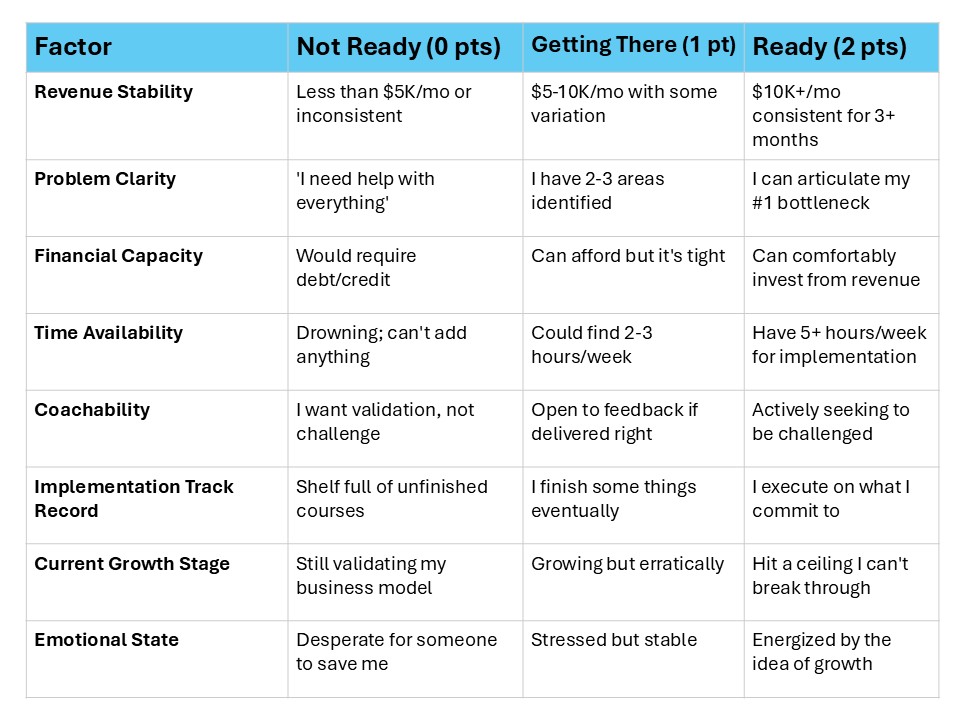
Take each factor in the first column and select ONE statement from any of the 3 columns on the right.
Then score yourself the points as suggested at the top of the column.
EXAMPLE: Factor: Problem Clarity. Choice: Getting There. Points =1
Total your points and score yourself as follows:
0-5 points: Not ready – Focus on building your foundation first.
6-11 points: Getting there – Work on the specific areas where you scored 0-1.
12-16 points: You’re ready – Start researching coaches who specialize in your specific challenge
Here’s what nobody tells you:
The decision to hire a coach is often less about whether you’re ‘ready’ in some perfect sense, and more about whether you’re willing to bet on yourself.
Let’s face it. You’ll never feel 100% ready. You’ll always have some doubt. The money will feel like a lot (because it is). There will be other ways you could spend it.
But here’s the data: 70% of individuals who receive coaching report improved work performance. 51% of companies with coaching report higher revenue than those without. 96% of those who hired coaches say they would do it again.
Okay, so you’ve determined you’re ready. Great!
But you run the risk of still wasting your money on a coach who might end up making things worse.
You see, the coaching industry is largely unregulated. Anyone can call themselves a coach.
Therefore, it’s up to you to be able to spot a “fraud” when you’re hiring a business coach.
So here are some red flags that should send of warning bells in your head and lock your money in your pocket:
If their sole credential is ‘I coach coaches,’ that’s a problem. This is the Instagram coach for Instagram coaches phenomenon. They’ve never actually built and scaled a real business—they just teach other people to coach.
What to look for instead: A coach who has actually done the thing you want to do. They’ve built a business, scaled it, had employees, dealt with real problems. Their coaching business should be one of their credentials, not the only one.
A close first cousin to #1 above. World-renowned coach Alan Weiss, PHD believes that a “coaching university” certificate means little by itself. He asserts that if you are a coach, you should have “been there and done it excellently and repeatedly.” And that’s how you look past “coaching qualification.”
What to look for instead: Remember you’re looking for results and improvement. So along with any qualifications check for quality and depth of experience as well.
If a coach is pitching to you and declare something like ‘I’ll grow your business by 10 times in 90 days!’ or promise ‘Guaranteed 6-figure launch!’ walk away (or run if you’re fit!) No ethical coach should guarantee specific financial outcomes—there are too many variables in the process they can’t control.
What to look for instead: A coach who sets realistic expectations, talks about the work required, and is honest about challenges you might face. For example, I find one of the biggest implementation challenges my clients face is their own personalities.
‘You have to decide right now.’ ‘This price is only available if you sign today.’ Making you feel guilty, ashamed, or pressured to give an answer immediately is manipulative and gross. However a coach can speed up your decision by writing a great proposal that is clear enough that you understand what you’re getting quickly.
What to look for instead: A coach who gives you space to think, discuss with your spouse/partner if needed, and make a decision that feels aligned. The right coach wants clients who are hell-yes, not clients who felt cornered.
If someone wants you to hire them as a business coach and their whole brand is “look how rich I am” – Rented Lamborghinis. Private jets. Mansions – that’s a warning sign. Not only might the sources of their income be suspect, but this sales approach in no way indicates what you would be getting from hiring them.
What to look for instead: A coach who focuses on client results, not personal luxury. Their testimonials should be about how they helped others, not how they bought a yacht.
‘Build a Facebook group and convert them to clients!’ If during their preliminary discussion, potential coaches suggest strategies that worked 10 years ago, they haven’t evolved. They are selling nostalgia not systems and strategies that are relevant to the current business environment.
What to look for instead: A coach who stays current, understands today’s business landscape and can adapt strategies to your specific situation.

There is no one-size-fits-all in business coaching. (or in stretch pants!)
The timeline for seeing results from business coaching can vary quite a bit depending on what you’re working on, your starting point, and I have to add, your personality.
But here’s generally what you might expect:
Early wins (first 1-3 months): You’ll likely notice shifts in clarity, focus, and confidence pretty quickly. Many people report better decision-making, reduced overwhelm, and initial improvements in how they structure their time within the first month or two. Small operational tweaks often show up fast too.
Meaningful progress (3-6 months): This is typically when you start seeing tangible business results – improved systems, better team dynamics if you have staff, revenue changes, or significant progress on key goals you’ve set. You’re building new habits and ways of thinking that start to compound.
Substantial transformation (6-12 months): Deeper changes in how you operate as a leader, how your business runs, and sustainable growth patterns usually emerge in this timeframe. This is when the real strategic shifts and mindset work tend to pay off in measurable ways.
The above aside, the pace of success depends heavily on factors like:
Just keep your expectations realistic because one of the biggest reasons people feel like they ‘wasted money’ on coaching is they had Hollywood transformation expectations.