Last updated on October 12th, 2026 at 11:12 am
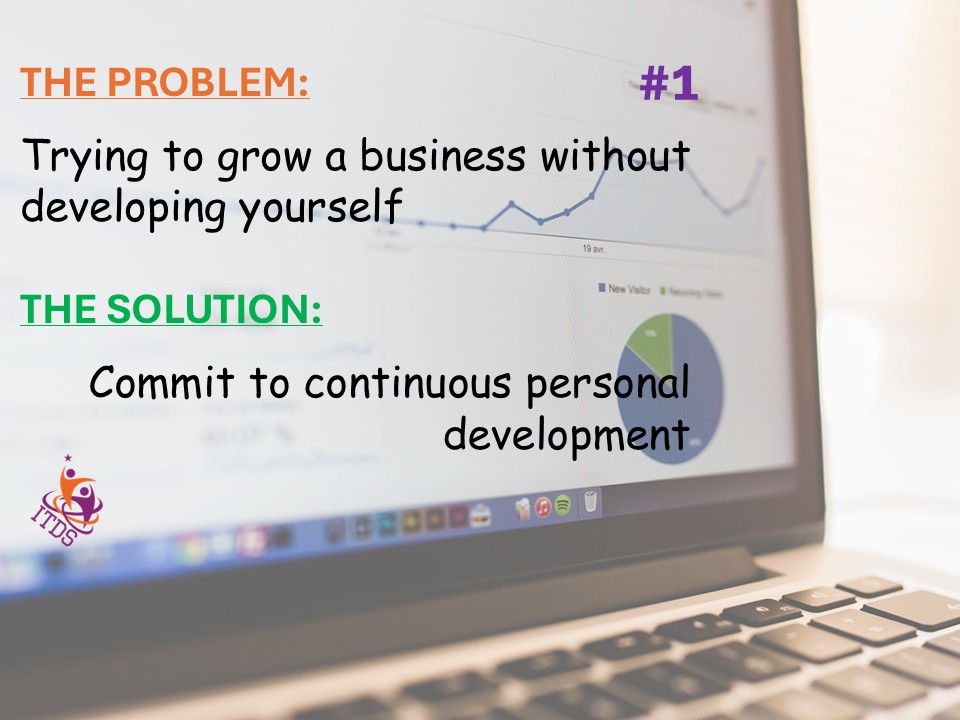
One of the biggest problems facing SBOs is that the average business person is trying to run a $20m with $5m thinking/skills (or some version of that!)
But as many of my clients, colleagues and even family members eventually discover, your business will only grow as fast and as far as you grow personally.
The underlying problem is that you understand acquiring a physical asset. It is tangible, it will be around for a number of years (hopefully!) and it will help you make money.
Spending money on personal or professional development is first of all seen as an unaffordable cost and not an investment. Furthermore, you cannot readily understand the connection between your growth and the growth of the business.
Unfortunately, I know that few external forces are going to persuade you to begin the process of focused learning. The desire has to come from within. Sadly, this desire is often only triggered when your business stops growing.
Whatever the trigger, here is a comprehensive post that lays out an approach to help you implement continuous learning as a key part of your personal development.
I can’t stress enough that when you educate yourself, you make better decisions in your business, you can improve your bottom line faster and when you face problems, you can recover far more quickly than if you’re “uneducated.”
And therein lies your strategy for growing your business through growing yourself.
I know. You have told me so:
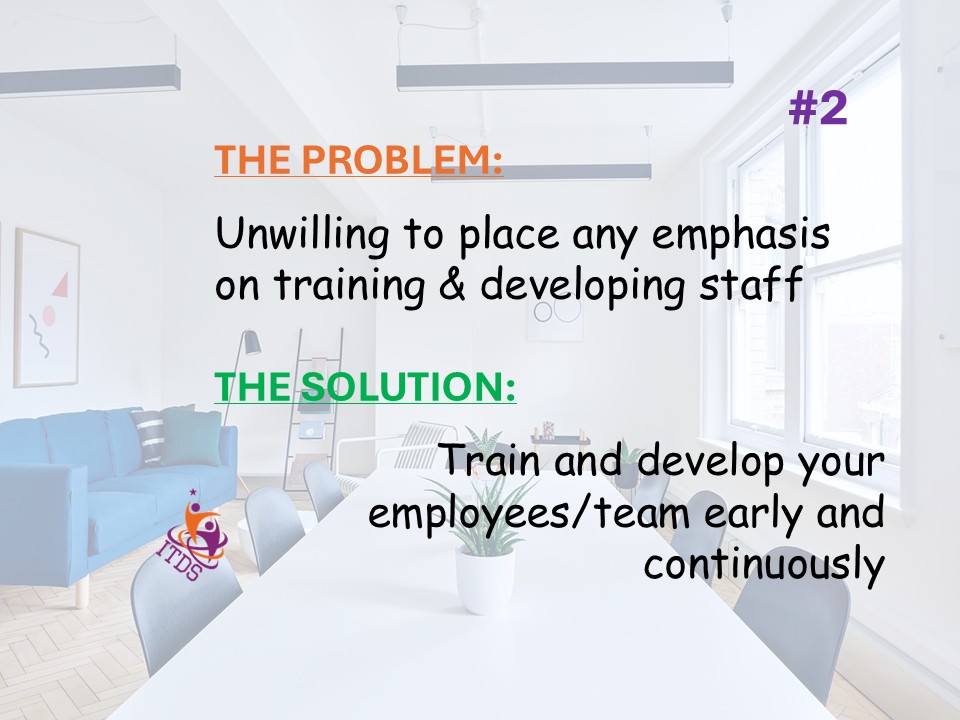
Your problem with training and developing your employees is that you are fearful that if you invest too much in training, employees will leave, taking what they learnt at your expense with them.
But even in casual conversations with SBOs, they will agree that having well-trained employees can indeed be one of the smartest and most valuable business solutions to their growth problems.
So my answer to your fear is usually: Have you considered what will become of your business if you don’t develop them and they stay?
You see, just as important as training and developing yourself is training and developing your employees or team.
In my opinion and experience, even when you have only 2 employees you need to be considering their development. This is an important route to growing your business fast.
Furthermore, when you can’t offer them the salary and compensation packages that a big business can, you can create opportunities for on-the-job training, coaching and mentoring.
These can prove to be equally valuable and attractive to your employees, especially when combined with other low/no cost employee recognition.
So don’t think of employee development or training as an unaffordable cost. Think of it as an unavoidable investment in valuable business solutions.
You accept that there is no disputing that some form of leadership is necessary for accelerating your business success.
However, your problem is that like your fellow SBOs, you have tried several approaches to this “leadership thing” and none seems to be working. Furthermore, you are also frustrated with the leadership theories which seldom seem to include your small business.
In reality, you want practical leadership steps, strategies and tools which you can apply to get results fast. And that’s quite understandable.
What might not be clear to you is that leadership occurs in a specific context and in a particular environment. For small businesses, the circumstances which require effective leadership skills are constantly changing and owners must be able to respond appropriately.
Therefore, the one thing you can do right now that will prove to be a valuable business solution is to be able to recognize the type of team(s) you are leading.
To explain this, I rely on author, consultant, coach Kevin Eikenberry’s concept of teams, a view which I support wholeheartedly.
He advances the argument that there are basically two types of teams – a basketball (hockey, football, netball) team and a track and field team.
The “basketball” team operates as a single unit in which regardless of the position you hold on that team, its success requires you to be flexible and be able to perform any or many roles on that team, at a moment’s notice.
The players depend on you the leader to forge that team into a single coordinated unit, working together to achieve your goals and grow your business.
The “track and field” team on the other hand, while representing the same club or organisation, and in this regard can be considered a team, they really operate independently of each other.
On the “track and field” team, if enough of the team members perform at a high level, the team will win – even though each team member act independently of each other.
What does all this mean for you?
Well, both types of teams can exist in your small business at the same time…and that’s okay. Your leadership success role is to recognize which type of team or if both types exist in your small business. Then you need to decide or discover how you will lead so that you create the “right” leadership for your business growth.
An important part of the “right” leadership, that’s among the valuable business solutions, is learning and applying the appropriate leadership skills to your business. This improves your productivity, enhances the closeness of the team and results in fully engaged employees. In a very short time.
Many SBOs build their businesses on foundations of rigid and inflexible rules and practices, confusing rules with systems.
In my experience, they are usually those entrepreneurs who previously work for big corporations, take a “package” and decide their next step is to work for themselves.
As to be expected, they follow the rules they know and instead of small businesses, they end up setting up small bureaucracies. And when they do, they fail to exploit a great competitive advantage – being flexible and adaptable.
Being flexible determines how, and how fast you generate more sales, lower your operating costs, make more productive use of your time and of course strengthen ties with your customers and your team.
When you’re adaptable, you are able to respond to market and business conditions or any other challenges you meet in your business environment, if you are to first remain in business and then to grow that business.
Being flexible does not mean you are not true to yourself and your business like my friend believes.
But it can mean that, for example, you recognise changes in customer preferences and change the business structure or the production methods to readily respond to these.
Being flexible can take many forms, especially if you’re creative. Here’s an example from one of our businesses.
The business is run almost completely by my son but his job title is not CEO, (we never use that anyhow) it’s Operations Manager. This allows him the flexibility to “Get back to the office” if he does not want to rush a decision and to make a decision on the spot if it’s advantageous to the business.
So please, make flexibility and adaptability a part of your business model.
Remember: Being flexible in and with your business is the ultimate flex!
You are busy. So busy working that in fact, you have little time for much else. What you do not realise is that if you’re busy once in a while, that’s a situation. If you’re busy all the time, it’s an unproductive personal strategy.
For me, personal productivity is consistently completing those tasks or activities which move you closer to accomplishing your goals, in a manner that brings balance and ease in your life.
When you take it to work, it becomes another one of the valuable business solutions which helps you to get more done in the time available to you, without the accompanying stress. (See #8 below.)
But personal productivity won’t improve by accident.
For some of you, it requires a painful separation of sluggish bum from comfy chair and actually taking action to get something done.
For others, it means a reluctant change in mindset. Instead of constantly trying to find time for important projects in an already busy schedule, you have to priotise and make time for what’s important first.
For me being productive means having an efficient productivity system that enables me to reach my goals in the shortest possible time.
And yes…I do have such a system. I call it my COPE system. It has only 4 steps and here’s how it can work for you:
As you do, you will realise that they might be some with a common theme. You can then group these into projects. For example, “return call to customer A”, “create a more friendly returns policy” and “fix problem with online shopping” can be grouped under a project called “Customer Care Activities”.
I like to organise mine by which could have the most impact or give me the best results in a particular time frame.
This is usually based on your timeframe and how you had organised them. Now within each project you have selected, Also priotise which tasks you should do first.
If you have followed steps 1-3 up until now, you will be able to do what must be done in a calm and methodical manner.
I really have to tell you that the “execute step” can also be a harmonious blend of work, family and personal life. It can also be based on your circadian rhythm, how you “park” interruptive thoughts and ideas, your diet and how you develop completion criteria.
Yeah…improving your personal productivity is indeed another of the valuable business solutions!
Research shows that SBOs are not good at asking for help. This is a big part of the reason they have no systematic approach for building a strong personal network to help speed up their business growth.
Having a strong personal network is not only “right up there” as valuable business solutions to grow your business fast, it’s about building relationships through networking and making a friend before you need a friend.
It is surrounding yourself with Mentors, Coaches, Masterminds, Circles of Experience, Advisors, whatever you want to call them – to accelerate your business success.
However, the real value is in building that network in a very focused way. Here are some tips to help you select the type of people you need:
Folks who can help you find a critical piece of software at a moment’s notice … or who are wired into your market in ways that allow them to know what’s working and what’s not … or who have solved business problems like yours for themselves or others … or who have a genius for brainstorming business solutions – you decide.
People who can send you qualified prospects when you need to hire “the perfect” employee for a particular position; business owners and executives who control crucial resources — TV production units, training rooms, computer equipment, and other assets that could come in extremely handy in growing your company.
— or anyone on your staff who can: Graphic Designers, Business Breakthrough Specialists, Business Coaches.
But in order to really have a great team of providers and partners, you’re going to have to locate them, begin a relationship with them, add them to your network and keep them in your network, long before you’ll ever need them.
How hard is that? It’s up to you…
One of the hidden problems that SBOs have, that really undermine their growth, is the tendency to focus on what they were trained to do, paying little attention to the other aspects of the business.
In fact, several SBOs have confessed to me, that a serious flaw in their approach to business, is that they had convinced themselves that learning about business goes against the very essence of being an entrepreneur.
And yet, they identify “seeing the big picture” as a business solution that can really speed up the growth of a business.
I do not question this contradiction, because over time I’ve come to realize that in most cases, this position is really a cover for fear of exposing weaknesses in the areas of business where their knowledge is limited.
The reality is, staying in business and growing your business requires you to see the big picture of your business, especially the external context.
To help you do that, let’s think of your business as a puzzle of many pieces which you must fit together.
A smart way to fit a puzzle together is to first become familiar with the picture on the cover of the box – the big picture. Only this time you will write down a description of your business’ big picture.
Then, when you begin to fit the pieces together, you will have a good idea which pieces you will need to connect first and how this will help you to complete the “puzzle” in the fastest way possible.
For example, Let’s say that you decide that your key systems or “puzzle pieces” are Human Resources, Customer Service, Team Building, Personal Development and Marketing.
When you have a good idea of your big picture, you can better fit the pieces together so that it represents another one of your valuable business solutions.
If you approach your business development in this way as early in the process as possible, you will achieve your business growth maybe even faster than you expect.
There are many reasons why SBOs procrastinate or appear to be “stuck in place” – fear of failure, imposter syndrome, mental fatigue, perfectionism are but a few of those reasons.
The problem is, procrastination hits small business owners harder than most, because there’s no boss setting deadlines and every task competes for your attention. So you end up avoiding many important tasks.
However, if you’re going to really explode your business success, taking action to keep you moving forward, must be your business solution of choice.
Here are a few approaches you can start with to keep you moving forward:
As you work through the above tips, learn to embrace a “do-it wrong-fast” mindset, knowing that you might not get it right the first time, but knowing that taking action will create the clarity you want.
Remember: You can’t let procrastination take you out. You have to keep moving forward. You have to be always taking action.
I’m not making excuses for SBOs who exhibit poor communication skills but I do understand why the problem exist. For example:
While I understand your problem, you need to understand that poor communication is a “make or break” for your business.
When you master the skill, you give yourself a valuable business solution to your growth problem. When you struggle with poor communication, you offend customers, you create conflict among employees and undermine your own growth and that of the business.
Now here are a few practical tips you can use to begin to uplevel your communication skills fast so you’re not so easily triggered by emotions:
If you only start with three things, you will make a positive difference in how you communicate.
Now while the above is a quick start, plan to get more professional training in communication skills over the long term.
Even as they acknowledge marketing as a powerful business solution to explode their business growth, many business people, like those in my mastermind group, are actually afraid of marketing and will avoid it at all costs.
But what is marketing?
Never mind the highfalutin definitions you hear, simply stated, marketing is everything you do to place your product or service in the hands of potential customers in return for a profit for yourself.
So why this palpable aversion to marketing?
Some of the reasons I found include:
The above aside, your business needs marketing so that people can get to know you exist.
So if you have a limited budget or a healthy distrust of agencies, you have to do it yourself. This requires you to start by building a series of relationships, because for SBOs, marketing requires that you market yourself along with your products and services.
The problem here is that you are uncomfortable “putting yourself out there.”
Here are 3 great marketing tips to help you, provided by Clate Mask, Co-Founder of Infusionsoft and Keap:
The majority of small businesses are inconsistent in their follow-up. They might send an email or direct mail piece and then wait months before sending another one. Without consistency, your prospect has no idea who you are.
Furthermore, inconsistency can cause a perception of ineffectiveness. Nobody wants to buy from a company they don’t trust.
Too often entrepreneurs, struggling to survive, send emails and direct mail pieces simply to promote their products. Now, promoting your products is great. But you need to do a lot more than that with your marketing.
Your marketing messages should be positioning you as a respected authority in your industry. Be sure to include testimonials, endorsements, and awards your company has won, along with your sales message.
Your follow-up must be informative. You need to provide valuable information. If you’re showing up with no value, you’ll wear out your welcome fast. You need to communicate that you are on their side and deserve to be trusted. You’ll accomplish this if you provide them with accurate, insightful information.
Just remember, when your marketing becomes consistent, promotes your expert status, and educates your prospects, you will soon have prospects knocking at your door, rather than you knocking at theirs.
Want a valuable business solution to really explode your business growth? Marketing will do it for you!